


US Trademark Registration: Complete Guide for Businesses and Foreign Entrepreneurs

Updated August 2026
If you already have a business name, you have probably run into a version of this question: you formed an LLC, maybe you registered a domain and set up social accounts, and now you are wondering whether the name itself is actually protected, or whether anyone could still use something close to it. This comes up constantly with founders who are entering the US market from abroad, since forming the company and protecting the brand feel like the same task and are not.
Registering an LLC gives you the right to use a name for tax and banking purposes in one state. On its own, it does not stop another business elsewhere in the country from using an identical or confusingly similar name for a similar product or service. US trademark registration is the separate, federal process, run through the United States Patent and Trademark Office (USPTO), that actually establishes nationwide rights in a brand name, logo, or slogan for specific goods or services. This guide walks through who typically needs one, whether foreign founders and companies with no US presence can apply, what the process and current costs look like, and where a US-licensed attorney becomes necessary rather than optional.
US Trademark Registration: Quick Answer
US trademark registration is a federal process, handled by the USPTO, that gives a business documented rights to use a name, logo, or slogan for specific goods or services nationwide. Anyone can apply, including individuals and companies based outside the United States, but applicants whose permanent residence or principal place of business is outside the US ("foreign-domiciled" applicants) must be represented by a US-licensed attorney throughout the process. Filing an LLC, registering a business name, or buying a domain does not create trademark rights on its own; a trademark is a separate registration built around a specific mark and a specific list of goods or services. A typical application moves through search, filing, USPTO examination, publication, and, if unopposed, registration, followed by maintenance filings to keep it active. Costs and timelines vary by filing basis and class count, which the sections below cover in detail.
What Is US Trademark Registration?
A trademark is a word, phrase, logo, symbol, or combination of these that identifies the source of a product or service and distinguishes it from competitors. Federal registration, granted by the USPTO, gives the owner a legal presumption of ownership and the right to use the mark nationwide in connection with the specific goods and services listed in the registration, along with stronger tools to act against a confusingly similar mark used on related goods or services. It is not an absolute monopoly on a word: two businesses can register similar or even identical names in unrelated industries, and existing common-law or state-level users of a name can still hold rights that a later federal filing does not erase.
Trademark rights are territorial. A US registration protects a brand inside the United States. It does not automatically extend to India, the UK, the UAE, or anywhere else, and a trademark registered elsewhere does not automatically give rights inside the US. Businesses that plan to operate in more than one country generally need a country-by-country or treaty-based strategy, which is covered later in this guide.
Does Registering an LLC or Business Name Protect Your Brand?
This is where most founders get tripped up. An LLC registration, a "doing business as" (DBA) filing, and a domain name purchase all feel like brand protection, but each one does something narrower and none of them is a substitute for a trademark.
Registering an LLC establishes a business entity under state law. It does not automatically create federal trademark rights in the business name, and it is not a substitute for one. An LLC filing tells a state government that a company with a given name exists for tax, liability, and registration purposes. Most Secretary of State offices will refuse to register two identical LLC names in the same state, but they do not check the USPTO's trademark database, do not check other states, and do not check whether the name conflicts with an existing brand. A business name or DBA filing is narrower still: it lets a business operate under a trade name but does not, by itself, create any exclusive rights. A domain name registration only secures that specific web address.
Protection type | What it actually does | Geographic scope | Creates trademark rights against similar names? |
LLC / entity registration | Registers a business entity with a state government for legal and tax purposes | Single state | No, only blocks an identical name within the same state's entity registry |
Business name / DBA | Allows a business to operate and be paid under a trade name | Varies by state or county | No |
Domain name | Reserves a specific web address | Global, but only for that exact URL | No |
US trademark registration | Establishes federal rights in the mark for the specific goods or services registered | United States (federal) | Yes, within the scope of the registration and against confusingly similar later use |
A business plan that includes multiple states, e-commerce, or national marketing typically outgrows what an LLC filing alone can protect. The name can still be used, without conflict, by an unrelated business in another state, and an LLC filing offers no basis to object to that.
Why Register a Business Name as a Trademark?
Federal registration gives a business a documented, nationwide claim to its name for the goods or services it covers, which becomes more valuable the moment a brand grows beyond a single city or state. In practice, it tends to make it easier to challenge a competitor adopting a confusingly similar name, easier to enforce rights on marketplaces like Amazon through the Brand Registry program and on social platforms, and easier to license or sell the brand as a business asset later. None of this is automatic or guaranteed; it depends on how strong the mark is and how closely a later use overlaps with the registered goods or services.
For a company planning to expand into the US from abroad, registering the trademark early, ideally before a large marketing spend, reduces the risk of discovering a naming conflict after the brand is already established in the market. It is not a guarantee against disputes, but it puts the business in a materially stronger position if one arises.
Can a Foreigner or Non-US Company Register a US Trademark?
Yes. There is no citizenship or residency requirement to own a US trademark. Individual entrepreneurs, foreign-owned LLCs, and companies with no US office or employees can all apply for and hold a US federal trademark registration.
It is worth separating two things that get confused constantly: foreign ownership and foreign domicile. A US LLC that is entirely owned by a non-US individual is not itself "foreign-domiciled" if its principal place of business is inside the United States; ownership by a non-US person does not, on its own, trigger the attorney requirement below. What matters for that requirement is the domicile of the applicant on the trademark application, meaning the applicant's own permanent legal residence (for an individual) or principal place of business (for an entity). A founder who owns 100 percent of a US LLC but who lives and works outside the United States is personally foreign-domiciled even though the LLC is a US entity, and the analysis depends on exactly who or what is named as the trademark applicant.
Since August 2019, USPTO rules have required that any foreign-domiciled applicant or registrant, meaning an individual whose permanent legal residence is outside the United States or an entity whose principal place of business is outside the United States, be represented before the USPTO by an attorney licensed to practice law in a US state. This is commonly called the U.S. Counsel Rule, and it covers the entire trademark relationship: filing the application, responding to USPTO inquiries, and handling maintenance filings over the life of the registration.
In practice, this means a founder who personally lives in India, the UAE, the UK, or anywhere outside the US cannot file or sign a US trademark application without a US-licensed attorney representing the matter, regardless of whether the applicant is that individual or a US LLC the individual controls, if the LLC's own principal place of business is also outside the US. This is a legal representation requirement, not a paperwork formality, and it applies independently of whether the founder has already formed a US company. Coordinating trademark filing with an existing or planned US company formation is usually worth doing early, since the entity that will own the trademark and the entity operating the business are typically meant to be the same one.
For founders and companies also planning to protect the same brand outside the US, the Madrid Protocol, administered by WIPO, allows a single international application, filed through the applicant's home trademark office, to seek protection in more than 130 member countries, including the United States. It is a filing and administration mechanism, not a shortcut around USPTO examination, the U.S. Counsel Rule, or the substantive requirements of US trademark law.
How to Check if a Business Name Is Already Trademarked

The USPTO retired its old public search tool, TESS, in November 2023 and replaced it with Trademark Search, available at tmsearch.uspto.gov. It is the free, official starting point for checking whether a name is already claimed, but running one search and seeing no exact match is not the same as confirming a name is safe to use.
● Exact-name search: checks whether the identical wording is already registered or pending.
● Similar spellings and variants: alternate spacing, hyphenation, or minor spelling changes that could still be confusingly similar.
● Similar pronunciations (phonetic equivalents): names that sound alike but are spelled differently often conflict just as much as identical spellings.
● Related goods and services: a conflict does not require an identical name in an identical industry; overlapping or related categories can also block registration.
● Potentially conflicting marks: logos, design elements, and marks that are visually or conceptually similar, not just textually similar.
An exact-match search alone is not a clearance search, and not finding an identical result is not confirmation that a name is free to register or safe to use. A basic search misses phonetic equivalents, unregistered "common law" marks that are in active use but never federally registered, and state-level trademark registrations, all of which can still create a conflict. A professional clearance search, typically run by a trademark attorney or a specialized search provider, checks these additional layers and gives a reasoned opinion on the risk level of proceeding with a given name. That opinion is a risk assessment, not a guarantee that the USPTO will register the mark or that no one will ever challenge it. For a name a business intends to build a brand around, this step is usually worth doing before filing.
How to Register a Trademark in the USA
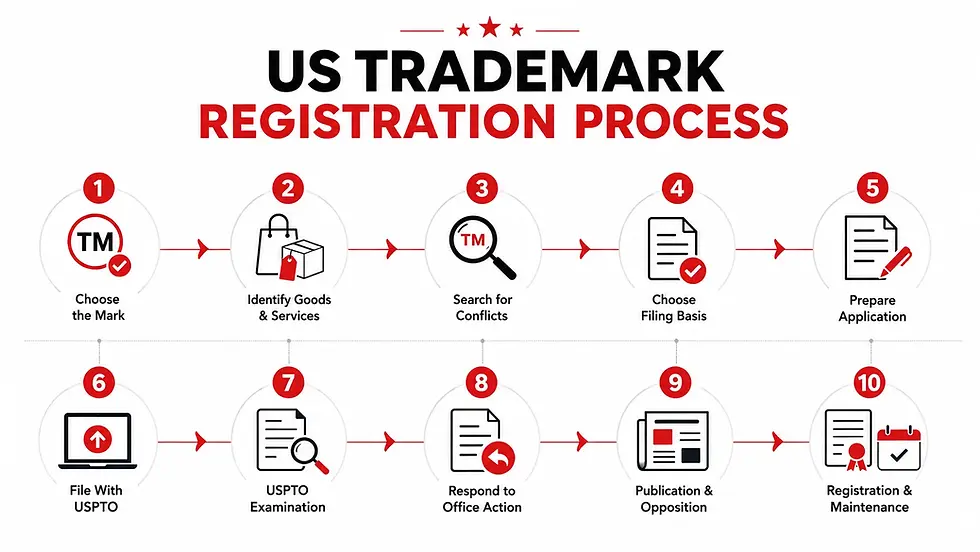
Filing a US trademark application follows a defined sequence. Each step affects the ones that follow, so skipping ahead (for example, filing before a proper search) is where most avoidable problems start.
Step 1: Choose the Mark
Decide exactly what is being protected: a word mark (the name itself, regardless of font or styling), a logo (a specific design), or both, which usually require separate applications. Distinctive, invented, or arbitrary names are generally easier to register than descriptive ones.
Step 2: Identify the Goods or Services
Trademark protection is tied to specific goods or services, grouped into international classes (for example, Class 25 for clothing or Class 42 for software as a service). The description needs to be accurate and specific; overly broad or vague wording is one of the most common reasons the USPTO pushes back on an application.
Step 3: Search for Conflicting Marks
Run a search, ideally a professional clearance search for anything beyond a low-stakes name, before filing. This is the point to catch a conflict while changing the name is still cheap.
Step 4: Determine the Filing Basis
The USPTO requires a legal basis for filing. The three most common are: Section 1(a), used when the mark is already in commercial use in the US; Section 1(b), an "intent to use" basis for a mark not yet in use; and Section 44(e), based on an existing registration in the applicant's home country. Foreign applicants relying on a home-country registration or the Madrid Protocol often use Section 44(e) or a Madrid-based filing instead of 1(a) or 1(b).
Step 5: Prepare the Application
This includes the applicant's legal name and domicile address, a clear drawing or representation of the mark, the classes and goods/services descriptions, the filing basis, and, for a 1(a) application, a specimen showing the mark actually in use (such as product packaging or a screenshot of a website selling the goods).
Step 6: File With the USPTO
Applications are filed electronically through the USPTO's Trademark Center system. Foreign-domiciled applicants must have a US-licensed attorney file and sign on their behalf, as covered above.
Step 7: USPTO Examination
An examining attorney at the USPTO reviews the application for conflicts with existing marks and for compliance with filing requirements. This is a substantive legal review, not a formality. The USPTO's own process and timelines page is the most reliable place to check current stage-by-stage timing, since it changes as USPTO workload changes.
Step 8: Respond to an Office Action if Necessary
If the examining attorney identifies a problem, they issue an Office Action explaining the objection and setting a deadline (typically three months) to respond. Missing the deadline results in the application being abandoned. Some Office Actions raise straightforward procedural issues; others raise substantive refusals, such as a likelihood of confusion with an existing mark, that are harder to overcome.
Step 9: Publication and Opposition
If the application clears examination, it is published in the USPTO's Official Gazette for a 30-day window during which any third party who believes they would be harmed by the registration can file an opposition or request more time to decide whether to oppose. Most applications are not opposed, but a contested opposition proceeding before the Trademark Trial and Appeal Board is a separate, court-like process that can add significant time and cost.
Step 10: Registration and Ongoing Maintenance
If there is no opposition, or it is resolved in the applicant's favor, a Section 1(a) application proceeds to registration. A Section 1(b) intent-to-use application instead receives a Notice of Allowance and must file a Statement of Use, with proof the mark is now in commerce, before registration issues. A registration is not protected indefinitely without upkeep. Under the USPTO's maintenance requirements, owners must file a declaration of continued use between the fifth and sixth year after registration, and a combined declaration of use and renewal application every ten years after that. Missing these deadlines, even after years of otherwise valid registration, results in cancellation that generally cannot be reversed.
What Information and Documents Do You Need?
The exact requirements shift depending on the filing basis and applicant type, but most applications need the following:
● The exact legal name and domicile (home or principal business) address of the applicant.
● A clear representation of the mark: the wording for a word mark, or a digital image for a logo.
● The class or classes of goods and services, described using the USPTO's ID Manual where possible to avoid surcharges.
● The filing basis (1(a), 1(b), 44(e), or a Madrid-based filing) and any supporting basis documents, such as a foreign registration certificate for a 44(e) filing.
● For a 1(a) application: the date of first use of the mark anywhere and in US commerce, plus a specimen showing actual use.
● For a foreign-domiciled applicant: a US-licensed attorney of record, since the applicant cannot sign or file the application directly.
None of this requires a US Social Security Number. Foreign applicants typically identify themselves by their business's formation documents and, where relevant, an EIN. Founders who already went through the process of getting an EIN for a US LLC often have most of the entity-level paperwork already on hand.
How Much Does US Trademark Registration Cost?
According to the USPTO's current fee schedule, the base electronically filed trademark application fee under Sections 1 and 44 is $350 per class of goods or services. That figure is the floor, not a fixed total cost, since several variables change what an applicant actually pays.
Cost component | What it covers |
USPTO government filing fee | The mandatory federal fee for the application itself, charged per class of goods or services |
Additional USPTO fees | Surcharges that can apply depending on how the application is prepared, such as incomplete filings or custom goods/services wording |
Additional classes | Each class of goods or services is filed and charged separately; a multi-class application multiplies the base fee accordingly |
Professional fees | Charges for a trademark search, application preparation, or attorney representation, which are separate from and in addition to USPTO fees |
Post-registration maintenance | Ongoing USPTO fees required at fixed intervals to keep a registration active after it issues |
A more detailed breakdown of the current USPTO fee items:
Fee item | Amount | When it applies |
Base application fee | $350 per class | Standard electronic filing using the USPTO's ID Manual for goods/services |
Insufficient information surcharge | $100 per class | Application is missing required information |
Custom (free-form) identification surcharge | $200 per class | Goods/services described outside the ID Manual's pre-approved language |
Statement of Use (intent-to-use applications) | $150 per class | Filed once the mark is actually in use, to complete a 1(b) application |
Extension of time to file Statement of Use | $125 per class | Filed if more time is needed before use begins |
Section 8 declaration of continued use | $325 per class | Due between years 5 and 6 after registration |
Section 9 renewal | $325 per class | Due every 10 years after registration, filed with Section 8 |
These figures reflect the USPTO's official fee schedule at the time of writing and are subject to change; the USPTO periodically adjusts its trademark fees, so it is worth checking the current schedule directly before budgeting a filing. Attorney and professional fees, which are separate from USPTO fees, vary by the complexity of the mark, the search performed, and whether any Office Actions need a response. Because of these variables, no single "total cost" figure applies to every applicant, which is why a filing basis and class strategy conversation usually comes before a cost estimate.
How Long Does US Trademark Registration Take?
There is no guaranteed timeline, and any source promising an exact number of weeks is oversimplifying. What can be said reliably is the shape of the process, and the USPTO's own trademark timelines page is the most current source for stage-by-stage estimates, since actual processing times shift with USPTO workload. In general, initial examination begins some months after filing, and a clean application with no Office Action and no opposition can reach registration within roughly a year. Each additional stage adds time on top of that baseline.
● An Office Action response period is typically three months, and a substantive refusal can take one or more rounds to resolve.
● The 30-day opposition window after publication can extend if a third party requests more time to decide whether to oppose.
● An intent-to-use application does not register until a Statement of Use is filed and accepted, which depends on when the applicant actually starts using the mark in commerce.
Applicants who need trademark protection ahead of a hard external deadline, such as a retail launch or a marketplace listing, should build in this uncertainty rather than assume a best-case timeline.
Why Trademark Applications Get Refused or Delayed
● Likelihood of confusion: the USPTO examiner believes the mark is too similar to an existing registered or pending mark for related goods or services.
● Merely descriptive marks: names that simply describe a feature, quality, or function of the product (for example, calling a bakery "Fresh Bread Co.") face a higher bar and can be refused outright or placed on a secondary register.
● Generic terms: the common name for the product or service itself can never function as a trademark, no matter how it is filed.
● Incorrect applicant information: filing under the wrong legal entity, an outdated business name, or an individual's name instead of the actual business owner of the mark.
● Incorrect or overly broad goods/services descriptions: vague wording invites an Office Action requiring clarification.
● Specimen problems: for a 1(a) filing, a specimen that does not clearly show the mark used in connection with the actual goods or services sold.
● Failure to respond: missing an Office Action deadline results in abandonment, regardless of how strong the underlying application was.
Do You Need a Lawyer for Trademark Registration?
For a foreign-domiciled applicant, this is not a judgment call: USPTO rules require representation by a US-licensed attorney for the entire life of the application and registration, as explained above. For a US-domiciled applicant, self-filing is technically permitted, but permitted is not the same as advisable for every situation.
Searches for lawyers for trademark registration usually come from people who have already sensed, correctly, that a self-filed application carries some risk. That instinct tends to be right in a few recurring situations:
● A name that is close to an existing mark, where a proper clearance opinion can prevent months of wasted filing fees and a forced rebrand.
● Multi-class applications or a broader portfolio strategy across several marks or countries.
● Any Office Action raising a substantive legal objection, rather than a simple formality.
● A dispute, opposition, or cancellation proceeding, all of which follow procedural rules that are difficult to navigate without representation.
Internation Corpus is a business formation and compliance platform, not a law firm, and it does not represent applicants before the USPTO directly. Its role is to help international entrepreneurs and companies coordinate trademark protection alongside their broader US business setup, and, where legal representation is required or advisable, to help clients connect with appropriately qualified, US-licensed professionals for that specific part of the work. The distinction matters: IC coordinates the business side of the process; a US-licensed attorney handles the legal representation that USPTO rules require for foreign-domiciled applicants and that many domestic applicants choose to use as well.
Trademark Registration for Small Businesses
Not every small business needs a federal trademark on day one. Registration tends to make the most sense once a name is settled, the business is selling (or about to sell) across state lines or online nationally, and the brand is worth defending, meaning there is real marketing investment or customer recognition behind it.
Common mistakes small businesses make with trademarks include:
● Assuming an LLC filing already covers trademark protection, then discovering a conflict after significant marketing spend.
● Filing an application before running any real search, then facing a refusal or forced rebrand.
● Choosing an overly descriptive name that is hard to register at all.
● Registering only under a personal name or an outdated entity, creating ownership confusion later.
● Forgetting that registration is not permanent without maintenance filings, and missing the Section 8 or Section 9 deadlines years later.
US Trademark Registration for International Businesses
For a foreign founder or an international company entering the US market, a handful of decisions tend to arrive at the same time: which entity should own the trademark, how that entity is structured, when to actually enter the US market, and how trademark protection fits alongside protection the business may already hold, or plan to seek, in other countries. Treating these as one decision rather than a sequence of separate ones tends to produce a cleaner result.
Ownership is worth deciding early. The entity that will own the US trademark, hold the US bank account, and sign US contracts is often the same LLC or corporation being formed to operate in the country, which is one more reason to line up trademark filing with company formation rather than treating them as unrelated projects.
It also helps to be precise about what US registration does and does not do internationally. A US trademark registration does not extend automatically to India, the EU, the UK, the UAE, or anywhere else, and a registration in another country does not extend automatically to the US. Businesses expanding into several markets generally need either separate national filings in each country or a Madrid Protocol application, administered by WIPO and recognized by the USPTO as a route into the US system, that designates multiple member countries through a single filing. The Madrid Protocol is a filing and administration convenience, not a single worldwide trademark: each designated country still examines the application under its own laws, and the US Counsel Rule still applies to the US portion for a foreign-domiciled applicant.
The realistic way to think about protecting a brand across multiple countries is as a market-by-market strategy, prioritized around where the business is actually selling or about to sell, rather than a single filing treated as blanket global coverage. Coordinating this with US company formation, an EIN, and US business banking as part of the same expansion plan reduces the chance of a gap, where the brand is exposed in one market while the paperwork for another is still in progress.
US Trademark vs Patent vs Copyright
| Trademark | Patent | Copyright |
Protects | Brand identifiers: names, logos, slogans | New, useful, non-obvious inventions or processes | Original creative works: writing, software code, art, music |
Granted by | USPTO | USPTO | Automatic on creation; can be registered with the US Copyright Office |
Duration | Indefinite, with ongoing use and maintenance filings | Typically 20 years from filing (utility patents) | Life of the author plus 70 years, in most cases |
Core requirement | Distinctiveness and use in commerce | Novelty and non-obviousness | Originality and fixation in a tangible form |
Common Mistakes to Avoid
● Assuming LLC or business name registration also protects the brand as a trademark.
● Filing an application before checking for conflicting marks.
● Searching only for the exact name and missing phonetic or visual equivalents.
● Selecting goods/services classes that are too broad, too narrow, or simply inaccurate.
● Misunderstanding the filing basis, especially confusing intent-to-use with actual use.
● Filing under the wrong applicant name or an entity that does not actually own the brand.
● Ignoring USPTO correspondence or missing an Office Action deadline.
● Assuming that filing, or even hiring a professional, guarantees approval.
● Forgetting that a registration requires maintenance filings years down the line to stay valid.
Do You Need US Trademark Registration?
Not every business needs to register on day one, and registration is not automatically the right move for every situation. The table below is a starting point, not a rule.
Situation | What to consider |
New business entering the US market | Run a proper trademark search and think through registration strategy before heavy marketing spend |
Already formed a US LLC | Check trademark protection separately; the LLC filing does not cover it |
Foreign founder | Work out trademark ownership and structure alongside the US Counsel Rule's attorney representation requirement |
International company entering the US | Treat US trademark protection as part of market entry planning, not an afterthought |
Proposed name is similar to an existing mark | Get a professional clearance opinion before filing or investing in the brand |
Growing small business | Weigh the cost of federal registration against how much the brand's nationwide recognition is actually worth defending |
Frequently Asked Questions
How much does US trademark registration cost?
The USPTO's base fee is $350 per class for a standard electronic application. Surcharges can apply for incomplete or custom-worded applications, and attorney fees are separate and vary by complexity, so total cost depends on the specific filing.
How long does US trademark registration take?
A clean, unopposed application can reach registration in roughly a year from filing, but Office Actions, oppositions, or an intent-to-use basis can extend that considerably. There is no fixed or guaranteed timeline.
Can a foreigner register a trademark in the USA?
Yes. Anyone, regardless of nationality or residency, can own a US trademark. Foreign-domiciled applicants must be represented before the USPTO by a US-licensed attorney throughout the process.
Can I trademark my business name?
Generally yes, provided the name is distinctive enough (not merely descriptive or generic) and does not conflict with an existing registered or pending mark for related goods or services.
Does an LLC protect my business name?
No, not in the way a trademark does. An LLC filing only prevents an identical name within the same state and does not create nationwide rights against similar names used by others.
How do I check if a name is already trademarked?
Start with the USPTO's Trademark Search tool (tmsearch.uspto.gov) for an exact-name check, but treat it as a first step. A full clearance search also checks phonetic variants, related goods and services, and unregistered common-law use.
Do I need a lawyer for trademark registration?
It is legally required if you are a foreign-domiciled applicant. For US-based applicants it is not mandatory, but professional advice is valuable for anything beyond a simple, clearly distinctive, single-class filing.
What documents are needed?
Typically the applicant's legal name and address, a representation of the mark, the relevant classes and goods/services description, the filing basis, and, for marks already in use, a specimen and dates of first use.
Can an international company register a US trademark?
Yes, including a company with no US office or employees, provided it appoints a US-licensed attorney as required for foreign-domiciled applicants.
Can I register a trademark before launching my business?
Yes, through an intent-to-use (Section 1(b)) application, which reserves priority in the mark before it is actually in commercial use, with proof of use required later to complete registration.
Need Help With US Trademark Registration?
The right next step depends on specifics: whether the applicant is US-based or foreign-domiciled, whether the mark is already in use or still pre-launch, how many classes are involved, and how close a proposed name is to anything already on the register. There is no single answer that fits every applicant, and nothing in this guide substitutes for advice on a specific mark and a specific business.
Internation Corpus works with international entrepreneurs and companies on US business formation, compliance, and expansion, and helps clients coordinate trademark protection as part of that broader plan. Where legal representation is required, which applies to every foreign-domiciled applicant, or simply advisable, IC can help connect clients with appropriately qualified, US-licensed professionals for that part of the work. Discuss your trademark requirements with Internation Corpus to work out where a US trademark fits into your company formation and market entry plans.


Comments