


How to Register a Trademark: Requirements, Costs & International Process

Updated: 6 days ago
To register a trademark, you search for conflicting marks, choose the classes of goods and services that match your business, decide which country or countries you need protection in, and file an application with the relevant trademark office. Once approved, the registration gives you a legal right to use that brand name, logo, or phrase in the country where you filed.
Here is the one thing every business owner should know before going further: no single trademark registration protects a brand in every country. Trademark rights are territorial. A mark registered in the US carries no legal weight in the UK, the UAE, or anywhere else unless it is also registered there.
So the real question is not just "how do I fill out the form." It is what you are protecting, where you need protection, which classes apply, and whether to file country by country or through a system that reaches several countries at once. This guide walks through the full process, with extra attention to what changes when a business operates, sells, or expands across borders.
What Is a Trademark?
A trademark is a legal right over a specific sign that identifies a business's goods or services and tells them apart from competitors. It does not protect a product or service itself. It protects the name, logo, or phrase attached to it.
Depending on the country, a trademark can cover:
A brand name or business name used in commerce
A word or invented term
A logo or stylized design
A slogan or tagline
In some countries, sounds, colors, or packaging shapes, though these are treated differently from place to place
Not every type of mark can be registered the same way everywhere. What qualifies in one country may face different rules in another.
What Can You Trademark?
Can You Trademark a Business Name?
Yes, but this is where founders most often get confused. Incorporating a company gives you a legal entity name recognized in the country where you formed it. That is a company registration, and it is not the same as a trademark.
A company can be legally incorporated under a name that infringes someone else's existing trademark. Incorporation alone gives you no exclusive right to use that name commercially. If customers know your business by a brand name, that brand name is what needs trademark protection. Forming the company does not cover it.
Can You Trademark a Brand Name?
Yes. Most businesses register their brand name as a "word mark." The more distinctive the name, the easier it usually is to register and defend. An invented or unusual name clears searches more easily and holds up better in disputes than a generic or descriptive one.
Can You Trademark a Logo?
Yes. A logo can be registered separately from the business name. This is worth doing if the logo appears on its own, such as on packaging or an app icon, without the name always next to it.
Can You Trademark a Word?
Yes, if it is distinctive enough. A common word used in its ordinary sense (naming a bakery "Bread," for example) is much harder to register than an invented or arbitrary term.
Can You Trademark a Phrase or Slogan?
Yes, if the phrase acts as a brand identifier rather than a plain description of the product. A tagline customers specifically associate with your business is more likely to qualify than a generic marketing line.
Do You Need to Register a Trademark?
There is no single rule here. Whether it matters for you depends on your industry, your growth plans, and how much of your business value sits in the brand itself.
Registration tends to matter more when you are:
Building a long-term brand rather than a short-lived project
Entering a new market or country
Selling under a name or logo that is central to how customers find you
Expanding internationally
Worried about a competitor using a confusingly similar name
If your business name matches your legal entity name and you have no plans to expand or license the brand, the urgency is lower. If your brand is your main asset, it matters a lot more.
When Should You Register a Trademark?
Timing depends on your situation, but a few patterns are worth knowing.
Before investing heavily in a market. Before spending months on a website, packaging, or local marketing in a new country, check whether your name is available there. Building a presence around a name that later conflicts with a local trademark costs far more to fix than a search would have cost up front.
Before or after company formation. It depends. A common sequence is: form the company, finalize the brand name, run a trademark search, secure trademark rights, then expand carrying that trademark abroad. But this is not a fixed rule. Some founders secure trademark rights before incorporating anywhere, especially when the brand matters for fundraising. Others incorporate first and formalize trademark strategy once there is revenue to justify it. What matters is treating the search and the filing as a deliberate step, not something that only gets attention once a copycat forces the issue.
During international expansion. Each new country is a fresh decision on trademark protection. It is not an automatic extension of protection you already hold elsewhere.
What Are the Requirements to Register a Trademark?
Exact requirements differ by country, but most applications ask for the same core information:
Applicant or owner details. The individual or company that will own the registration.
A clear representation of the mark. The exact word, logo, or phrase being registered.
The goods and/or services covered, described using the relevant trademark classification.
The trademark classes that apply to your business.
The filing jurisdiction. Which country or system you are filing through.
Supporting documents, where the country requires them. This can include a power of attorney, a certified priority document, or proof of a home registration.
Use or intent-to-use information, where applicable. Some countries require proof the mark is already in commercial use. Others accept a genuine intent to use it.
Some jurisdictions add requirements that do not exist elsewhere. The clearest example: the USPTO requires foreign-domiciled applicants to be represented by a US-licensed attorney. More on that below. Always confirm the specific trademark office's current requirements before filing.
How to Register a Trademark: Step by Step

Step 1: Decide What You Want to Trademark
Define exactly what you are protecting: a brand name, a logo, a word, a phrase, or some combination. Vague or shifting versions of a mark cause problems later, since the exact form you file is generally what gets protected.
Step 2: Search for Existing Trademarks
A trademark search checks whether your mark conflicts with something already registered. A useful search looks beyond exact matches. It should also catch names or logos similar enough to cause confusion, cover the classes relevant to your goods or services, and be run separately in each country you are targeting. A clear result in one country tells you nothing about another.
No search gives certainty. It reduces risk, it does not remove it. Skipping this step is one of the costliest mistakes a founder can make, since a rejected or opposed application still costs the filing fee, and rebranding afterward costs far more than the search would have.
Step 3: Decide Where You Need Protection
Trademark rights are territorial (more on this below). Consider the countries where you:
Currently operate or sell
Manufacture or source from
Run paid advertising or marketing
Have your most significant customers or revenue
Have concrete, near-term plans to expand
You do not need to register everywhere. Just where there is real commercial activity or real risk.
Step 4: Choose the Correct Trademark Classes
Trademark systems group goods and services into numbered classes under the Nice Classification, an international standard used by most countries. Your registration generally only protects the mark for the classes listed in the application.
Filing under the wrong class, or leaving one out that you are already active in, is a common and avoidable error. But adding classes "just in case" also adds cost. Match the classes to what your business actually does, or plans to do soon.
Step 5: Choose the Filing Route
You can file directly with each national trademark office, through a regional system where one exists (like the EUIPO for the EU), or through the Madrid System, which lets you reach multiple member countries with one application, provided you already hold a basic mark at home. This decision gets its own comparison below.
Step 6: Prepare the Application
Gather the applicant information, a clear representation of the mark, the class list, and any required supporting documents. Confirm at this stage whether local representation rules apply. Some countries require a local attorney or agent, especially for foreign applicants.
Step 7: Submit the Application
File with the relevant trademark office, or through Madrid via your home office. Government filing fees are due at this point.
Step 8: Examination
The trademark office reviews the application for compliance and for conflicts with existing marks. Examination timelines vary a lot by country. Some offices examine within weeks, others take many months.
Step 9: Publication and Opposition
Many countries publish approved applications for a set period, giving third parties a chance to object. If no one opposes it, the application moves toward registration. If someone does, the process can take much longer and starts to resemble a legal proceeding rather than a routine filing.
Step 10: Registration
Once examination and any opposition period clear, the trademark is registered. From here, the responsibility shifts to maintaining it. See "What Happens After Trademark Registration" below.
How Does International Trademark Registration Work?

There is no single trademark registration that automatically protects a brand everywhere in the world. Every country examines and grants trademark rights on its own. Two broad approaches exist for reaching multiple countries.
Direct National or Regional Filing
You file a separate application with each country's trademark office, or with a regional office where one exists. The EUIPO, for example, covers all 27 EU member states with one application. Direct filing gives you more control over each application's details and works well when you only need one or two priority markets, or when the countries you need are not all Madrid members.
The Madrid System
The Madrid System is an international filing system run by the World Intellectual Property Organization (WIPO). It lets a trademark owner file one application, in one language, with one set of fees, to seek protection across more than 130 countries through roughly 116 member offices.
A few things matter before relying on it:
It requires a basic mark. You need an existing trademark application or registration in your home country (your "basic mark") before you can file internationally through Madrid.
Designation is not automatic registration. Each country you designate still examines the application under its own rules and can refuse it on its own. Madrid centralizes the paperwork, not the legal outcome.
There is a five-year risk period. During the international registration's first five years, it stays tied to the home application it was built from. If that home application is successfully challenged or cancelled in this window, the international registration can be affected too, even in countries where no one objected directly. This is known as "central attack."
There is a safety net. If central attack cancels the international registration, the owner can, within three months, apply to turn it into separate national or regional applications in each affected country, keeping the original filing date. Those applications still need each country's national filing fees and their own examination.
After the five-year window, the international registration becomes independent of the basic mark and is no longer exposed to this risk.
Madrid works well when you are pursuing several countries together and already have a basic mark. It is not the right starting point if you have not registered anything at home yet. This is a problem that trips up a lot of first-time international founders.
For a deeper, country-specific walkthrough of filing through Madrid, see Madrid Protocol Trademark Registration (2026 Guide).
The "No Home Mark Yet" Problem
A founder may have already formed a company, chosen a brand name, and decided they want protection in several countries, but not yet filed a trademark application anywhere. Without a basic mark, there is nothing for a Madrid application to attach to.
In this case, you generally need to file the home country application first, before Madrid becomes an option. Depending on urgency, this can mean filing at home and moving to Madrid once that is in place, or filing directly in your priority countries in parallel rather than waiting.
If a business is weighing this decision, planning the home filing and the priority markets together can save real time and cost. This is a sequencing question worth working through with an advisor before spending on either.
How Many Countries Should You Register Your Trademark In?
You do not need to register in every country. Trying to do so rarely makes sense for a growing business, since renewal fees pile up for markets you may never enter. A more useful approach is a short priority list:
Which countries are your current core markets?
Which are part of a concrete expansion plan, not just a long-term hope?
How much revenue or brand value is tied to each market?
How much competitive or counterfeiting risk exists there?
What does registration and renewal actually cost in each?
A business with a limited budget might start with two or three priority countries and expand filings as revenue grows, rather than covering everywhere at once.
How Much Does Trademark Registration Cost?
There is no single worldwide fee. Costs typically include:
Official government filing fees
Additional fees per class beyond the first
Professional or attorney fees
Search and clearance costs
Translation costs where required
Local representative fees where required
Opposition costs, if your application is challenged
Renewal fees over time
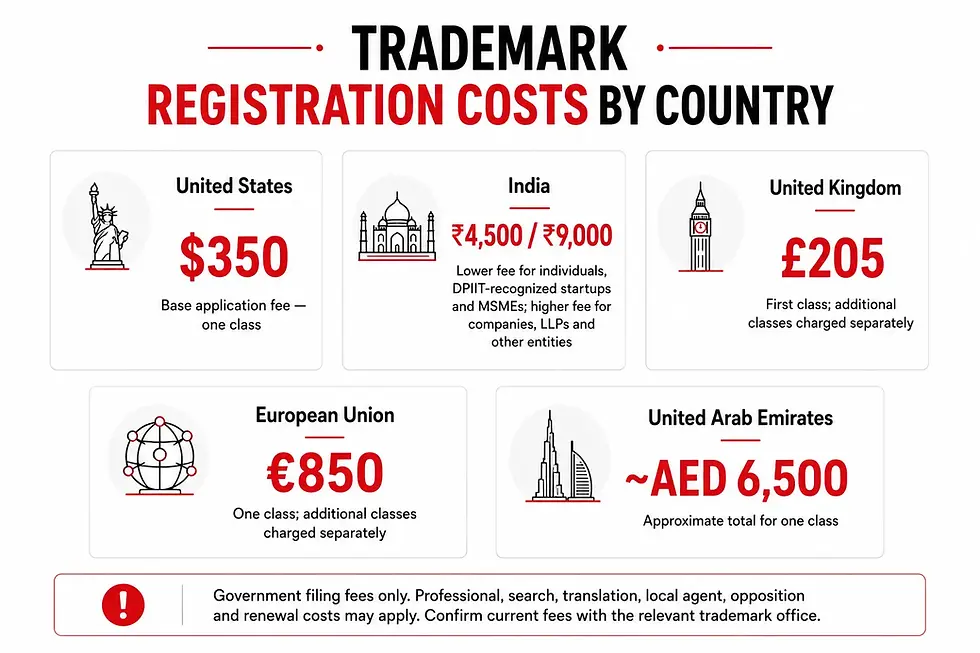
The figures below are official government filing fees only. They do not include attorney fees, search costs, translation, or local agent charges, which are separate and vary by provider. Fee schedules change, so treat these as a general sense of scale rather than a fixed number, and confirm the current rate directly with each office before budgeting.
Jurisdiction | Official government fee (one class, online filing) | Notes |
United States (USPTO) | $350 base application fee | Foreign-domiciled applicants must be represented by a US-licensed attorney. Using a custom goods/services description instead of the USPTO's pre-approved list adds a surcharge. |
India (IP India) | ₹4,500 for individuals, DPIIT-recognized startups, and MSMEs. ₹9,000 for companies, LLPs, and other entities. | Startups need DPIIT recognition and MSMEs need Udyam registration to claim the lower rate. |
£205 for the first class, £60 per additional class (effective April 2026) | Applicants without a UK, Gibraltar, or Channel Islands address need a local address for service. | |
European Union (EUIPO) | €850 for one class, plus €50 for a second class, plus €150 for each class after that | Covers all 27 EU member states under one registration. No separate fee once registered. |
United Arab Emirates (Ministry of Economy) | Roughly AED 6,500 total for one class, made up of separate filing, publication, and registration fees | Foreign, non-UAE-resident applicants must file through a registered local trademark agent. The UAE has recently added new fees for services like opposition and appeals, so confirm the current full schedule before budgeting. |
The Madrid System has its own separate fee structure paid to WIPO in Swiss francs: a basic fee, per-class fees beyond the first three, and a fee for each country designated. WIPO's own Madrid fee calculator is the most reliable source for current figures at the time of filing.
How Long Does Trademark Registration Take?
There is no single global timeline. Each country examines on its own schedule. In general, an application moves through a pre-filing search, filing, examination, a publication or opposition period, and then registration if nothing gets in the way.
The publication period usually makes the biggest difference. An uncontested application tends to move through in the shortest time the jurisdiction allows, often several months to a year in major jurisdictions, and longer for Madrid designations, which commonly run 12 to 18 months when nothing is contested. An office action (an objection from the examiner, often over classification or a similar existing mark) adds months while you respond. A formal opposition from a third party adds much more time, since it becomes closer to a legal proceeding than an administrative one.
Do You Need to Register Your Trademark in Every Country?
No, not necessarily. The goal is not blanket global coverage. It is protecting the markets where your business has real commercial activity or real commercial risk. Use the priority list above (current markets, concrete expansion plans, revenue concentration, competitive risk) to build your list, rather than filing everywhere "just in case."
Trademark Ownership and Your Company Structure
For a business with a single operating company, ownership is usually simple: the trademark sits with that company. It gets more complicated with a parent company and several subsidiaries operating across markets.
If the trademark sits with the parent, each subsidiary using it typically needs a documented license. If it sits with one operating subsidiary, the others are technically using someone else's registered mark. Neither structure is wrong, but the choice affects licensing, tax treatment, and what happens if part of the business is later sold or restructured. This is worth resolving in writing before it becomes a problem, not after.
Registering a US Trademark as a Non-US Business
This comes up often enough for international founders that it deserves its own section. It is worth treating as separate from the general international process above, since the US has rules that do not apply elsewhere. For the full filing walkthrough, see US Trademark Registration: Complete Guide for Businesses and Foreign Entrepreneurs.
Can a foreign business register a US trademark? Yes. The US does not require an applicant to be a US citizen, a US resident, or a US-incorporated company.
Do non-US applicants need a US trademark attorney? Yes. This is a firm requirement, not a recommendation. Since August 2019, the USPTO has required any applicant whose domicile is outside the United States to be represented by an attorney licensed and in good standing in a US state or territory. This applies to the initial application, any office actions, and ongoing maintenance.
Direct filing vs. Madrid designation to the US. A non-US business can reach US protection either by filing directly with the USPTO or by designating the US within a Madrid application. Both still require US legal representation once the US portion reaches examination. Direct filing gives more control over the application's details. A Madrid designation can be efficient when the US is one of several countries pursued together, but it inherits Madrid's central attack risk, described above.
Section 44(d) and 44(e). A foreign applicant can claim priority based on a home-country application filed within the prior six months (Section 44(d)). Note that 44(d) only secures an earlier filing date. It is not by itself a basis for registration.
Separately, a foreign applicant can base a US application on an existing home-country registration without first proving use in US commerce (Section 44(e)). This is a real shortcut, since the standard US route otherwise requires either current use in US commerce or a genuine, near-term intent to use it there. Even under 44(e), the owner still has to show use in US commerce eventually, typically at the first maintenance filing, to keep the registration in force.
What Happens After Trademark Registration?
Registration is the start of an ongoing responsibility, not the end of one.
Renewal. Trademarks need to be renewed on the schedule set by each country's office, or they lapse.
Monitoring. Keep an eye on whether similar marks get filed, or whether unauthorized use turns up in a market you care about.
New markets and classes. As the business grows, this can mean registering in newly entered countries or adding classes as your product or service lineup expands.
Ownership changes. If the trademark changes hands, through a sale, restructuring, or a change in which entity holds it, that has to be formally recorded with each relevant trademark office.
Licensing. If you license the brand to a subsidiary, franchisee, or distributor, document that arrangement. Unlicensed or undocumented use by another party can weaken your position later.
Enforcement. Acting against conflicting or infringing marks is an ongoing part of holding a trademark, not a one-time event.
Trademark vs. Company Name vs. Domain Name

These three registrations are often confused, but each does a different job. None substitutes for another.
Registration | What it protects or does |
Company registration | Creates a legal business entity recognized in that country |
Trademark registration | Grants exclusive rights to use a specific brand identifier, in the countries where it is filed |
Domain registration | Gives control over a specific web address. No bearing on trademark rights. |
A company can be incorporated under a name, and a domain can be live and active, while someone else holds the trademark rights to that exact name. Before committing heavily to a name, check availability in this order: the trademark register first, since it carries legal force, then the domain, then social handles.
Trademark status also matters for practical business decisions later. Banks and payment processors sometimes ask for evidence of a registered brand during account verification, especially when a business operates under a name different from its legal entity name. Amazon's Brand Registry also requires an active registered trademark, or a pending application filed with a recognized government trademark office.
Trademark vs. Copyright vs. Patent
Trademark. Protects brand identifiers such as names, logos, and slogans used to distinguish a business in commerce.
Copyright. Protects original creative works, such as writing, music, or software code.
Patent. Protects a new invention or functional process, for a limited period.
A trademark, unlike a patent, can in principle be renewed indefinitely as long as it stays in use and renewals are filed on schedule.
Common Trademark Registration Mistakes
Choosing a final brand name before running any trademark search
Assuming that incorporating a company also protects the brand name
Assuming one country's registration protects the brand worldwide
Filing in a long list of countries with no clear reason tied to actual markets
Overlooking countries that are part of a genuine near-term expansion plan
Filing under the wrong classes, or missing one already in use
Leaving trademark ownership unresolved across a multi-entity structure
Trying to use the Madrid System without a basic mark at home first
Ignoring central attack risk during a Madrid registration's first five years
Investing heavily in branding or marketing before confirming the name is available
Securing a domain and social handles without checking the trademark register first
Treating an outdated fee or timeline figure as current
Forgetting that registrations need ongoing renewal and maintenance to stay in force
Should You Register a Trademark Yourself or Get Professional Help?
DIY filing can work for straightforward cases: a single country, a clear mark, no conflicting results in the search, and classes that map cleanly to pre-approved descriptions. Professional help tends to earn its cost when:
Multiple countries are involved
The business is actively expanding internationally
The search turns up similar existing marks
Multiple classes are needed
Trademark ownership needs to be structured across a parent company and subsidiaries
The brand is a significant part of the business's value
Your filing strategy (direct vs. Madrid, sequencing, priority claims) needs coordinating
For a single home market with no near-term expansion plans, this is often a manageable DIY process. For businesses operating or expanding across borders, juggling different countries' requirements, local representation rules, and ownership structures, planning ahead saves both money and rework.
Internation Corpus works with international founders on exactly this kind of cross-border planning: mapping which countries actually need protection, sequencing a search-and-filing strategy against expansion plans, and fitting trademark ownership into the rest of the business's structure. No filing strategy can guarantee registration, but coordinating trademark planning alongside company formation, a registered agent, and the rest of your international setup helps you avoid the sequencing mistakes that cost founders the most time and money. If you are weighing where to file first, book a consultation to work through your priority markets and filing route before you spend on either.
Related Reading
US Trademark Registration: Complete Guide for Businesses and Foreign Entrepreneurs
More intellectual property guides on trademarks, copyrights, and patents
FAQ
How do you register a trademark?
Search for conflicts, choose your classes, choose your country or countries, and file with the relevant trademark office. Either directly, or through the Madrid System if you already hold a basic mark and want to reach multiple countries at once.
How do I register a brand name?
The same way as any other trademark. It is typically filed as a word mark, following the same search, classification, and filing steps.
How do I register a business name as a trademark?
Treat the brand name customers actually recognize as the mark to protect. This may or may not match your exact legal entity name. File it as a word mark in the relevant country or countries.
Can I trademark a word?
Yes, if it is distinctive enough. A common word used in its ordinary sense is much harder to register than an invented or arbitrary term.
Can I trademark a phrase?
Yes, if the phrase acts as a source identifier rather than a plain description of the product.
Can I trademark a logo?
Yes, and it is often worth registering separately from the word mark if it is used on its own, such as on packaging or an app icon.
Do I need to trademark my business name?
Not necessarily your exact legal entity name, but if customers know you by a brand name, that brand name is what needs trademark protection. Incorporation alone does not cover it.
Do I need a trademark for my business?
It depends on your industry, growth plans, and how much value sits in the brand itself. It matters more as you build a long-term brand, enter new markets, or worry about copycats.
How much does trademark registration cost?
It depends entirely on the country and number of classes. Government fees for one class currently range from roughly a few hundred dollars in some countries to over a thousand in others, before professional fees, and do not include search, translation, or local agent costs.
How long does trademark registration take?
It varies by country and by whether the application faces objection or opposition. Commonly several months to a year for an uncontested application in major jurisdictions, longer if contested or filed through Madrid.
Can I register a trademark internationally?
There is no single global trademark. You can seek protection in multiple countries by filing directly in each one, or through the Madrid System, which centralizes the filing but still results in separate national examinations.
Do I need to register my trademark in every country?
No. The goal is protecting the markets where the business actually operates, sells, or has concrete expansion plans.
What is the difference between a trademark and copyright?
A trademark protects brand identifiers used to distinguish a business in commerce. A copyright protects original creative works, like writing, music, or software code.
What is the difference between a patent and a trademark?
A patent protects a new invention or functional process for a limited period. A trademark protects a brand identifier and can be renewed indefinitely as long as it stays in use.
This article is general guidance, not legal advice. Trademark rules, fees, and timelines differ by country and change over time. Always confirm current requirements with the relevant national trademark office or WIPO before filing.


Comments