


Best Countries to Register a Company for UAE Residents in 2026
By IC Mentor | Last updated: September 2026
This guide is for people who live in the UAE and want to register a company in another country. It compares the United States, the United Kingdom, Singapore, Estonia and Hong Kong on what decides the choice: where your customers are, what banking you need, what local presence the country requires, and what the company costs each year.
It also covers the UAE side, which most guides skip. A foreign company does not automatically remove UAE corporate tax if you run it from the UAE. And registering a company does not mean a bank will open an account for it. Fees and rules were checked in September 2026, against official sources where possible.
Quick Answer
No single country is best for every UAE resident. The right choice depends on where your customers pay from and how you plan to get paid.
US customers and US dollar billing: a US LLC may suit.
UK or European clients: a UK Ltd may suit. The UK-UAE tax treaty has been in force since 2016. If you are weighing these two head to head, read our comparison of a US LLC vs a UK Ltd for UAE residents.
Asia-facing business: Singapore may suit, if you can meet its resident director rule. Hong Kong is more relevant for real China or Asia trade.
EU-facing digital business that keeps profit inside the company: Estonia may suit.
Mostly UAE customers: staying with a UAE mainland or free zone company is often simpler than adding a foreign one.
Key Takeaways
There is no universal best country. Match the jurisdiction to your customers, payment tools, banking needs and the paperwork you can manage.
Registering a company and opening a bank account are two separate approvals. Each bank or payment provider makes its own decision, so a registered company does not guarantee an account.
Running a foreign company from the UAE can still bring UAE corporate tax. The test looks at where the real decisions are made, not only where the company is registered.
The UAE has no income tax treaty with the US. It does have one with the UK.
Since August 2026, US-formed LLCs are exempt from federal beneficial ownership (BOI) reporting. A foreign-owned LLC still has to file Form 5472 with the IRS every year.
Formation fees are only the start. Yearly costs (registered agent, company secretary, nominee director, accounting, filings) usually matter more.
Before You Choose: 7 Questions to Answer First
Where do your customers pay from? The US, the UK and EU, Asia, or the UAE.
How will you get paid? Bank transfer, card payments, marketplace payouts or a payment processor.
Do you need Stripe or PayPal? Check each provider’s current rules for the country where your company is registered.
Do you need a traditional bank, or is a digital account enough? Our guide to business bank accounts for non-US residents explains how the options differ.
Can you meet the local presence rules? These can include a resident director, registered agent, company secretary or local contact person.
How much yearly paperwork can you manage? Every option here has filings, even with zero revenue.
Where will the real decisions be made? If you run the company from the UAE, read the tax section below before you register anything.
Comparison Tables
Table 1: Registration and banking at a glance
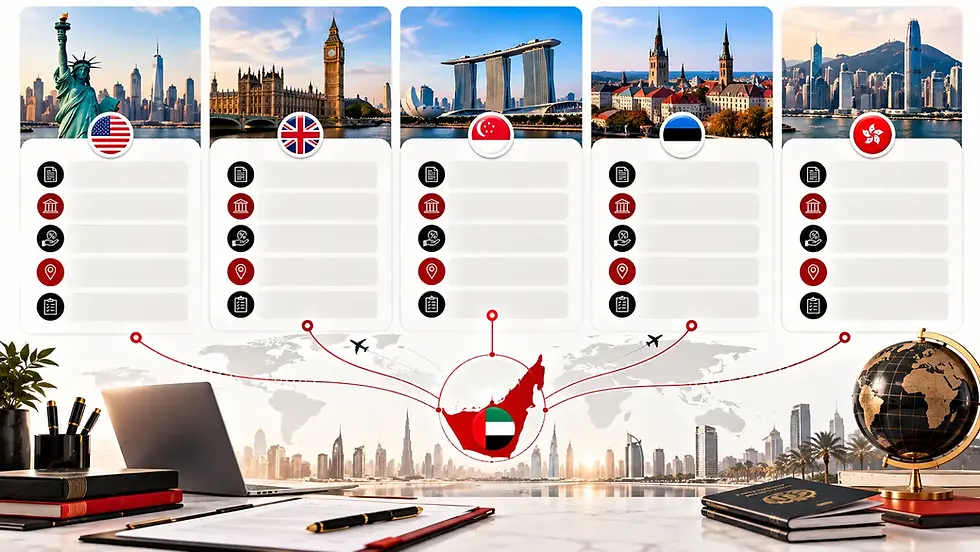
Country | May suit | Government fee to register | Local presence | Banking: what to expect |
United States (LLC) | US customers, US dollar billing | State fee, for example $100 in Wyoming or $110 in Delaware | No local director. A registered agent is required. | Digital providers may open accounts remotely. Traditional banks often want a visit. Each provider decides. |
United Kingdom (Ltd) | UK and European clients, consulting | £100 online (from 1 February 2026) | No local director. A UK registered office is required. Directors must verify their identity. | Some UK digital providers open accounts for non-resident owners. Rules vary by provider. |
Singapore (Pte Ltd) | Asia-facing business | S$315 (S$15 name plus S$300 registration) | One Singapore-resident director, a local registered address and a company secretary | Workable once the director and address are in place. Provider rules apply. |
Estonia (OÜ) | EU-facing digital business that keeps profit in the company | €265 state fee, plus the e-Residency card fee | No local director, but a contact person and address are needed if no board member lives in the EU. You collect your e-Residency card in person. | Traditional banks often decline non-residents. Many e-residents use an e-money account instead. |
Hong Kong (Ltd) | China and Asia trade | HK$3,895 in year one (HK$1,545 plus HK$2,350 business registration) | A company secretary and a registered office in Hong Kong | Banks often ask for local ties and an in-person meeting. |
Table 2: Tax and yearly upkeep

Country | Headline tax position | Main yearly obligations |
United States (LLC) | A foreign-owned single-member LLC has no US corporate tax by default. US tax can apply to certain US income. | Form 5472 with a pro forma Form 1120. Registered agent. State fees (Delaware $400 annual tax from the 2026 tax year, first payment due 1 June 2027; Wyoming annual report from $60). |
United Kingdom (Ltd) | Corporation Tax of 19% to 25% depending on profit | Annual accounts, Corporation Tax return, confirmation statement (£50 online) |
Singapore (Pte Ltd) | 17% headline rate. Some exemptions may lower the effective rate for smaller companies. | Annual return, corporate tax return, company secretary, nominee director if needed |
Estonia (OÜ) | 0% on profit kept in the company. Tax is due when profit is paid out. | Annual report, accounting, local contact person and address |
Hong Kong (Ltd) | Two-tier profits tax (8.25% on the first HK$2 million, 16.5% above that). Offshore claims are possible with evidence. | Annual return, audited accounts, profits tax return, business registration renewal |
Costs vary by provider, so they get their own section below.
Country-by-Country Comparison
United States (LLC)
UAE residents look at a US LLC when their customers, payment tools or partners are American.
May suit: businesses that bill US customers in dollars, sell through US marketplaces, or work with US-based software and payment tools. Freelancers and consultants who are unsure whether they need a company at all can start with our guide on whether you need an LLC as a freelancer.
How it works: A Limited Liability Company (LLC) is formed in a US state, most often Wyoming or Delaware. Foreign owners can hold 100%, with no US residency needed.
You file online and need a registered agent, which is a US address that receives legal mail. Every state requires one. Then you apply for an EIN, the US tax ID. Owners without a US Social Security number apply by phone, fax or mail, as the IRS instructions for Form SS-4 explain. Our guides explain how to register a business without a physical US address and the difference between an ITIN and an EIN. If you want support, see our USA LLC formation service.
Banking: Some digital business account providers may open accounts for non-US owners without a visit. Traditional US banks often still ask for an in-person branch visit. Approval depends on each provider’s current checks and on your business profile. Our US business banking support can help you prepare, but we cannot promise approval. For a provider-by-provider view, read our guide to US business bank accounts for non-residents.
Tax and filings: A US LLC with one foreign owner is usually treated as a “disregarded entity”, meaning it has no separate US income tax return. US tax generally applies only to certain US-source or US-connected income, so what you do and where the work happens matters.
Even with no US tax due, the LLC must file Form 5472 with a pro forma Form 1120 whenever it has “reportable transactions” with its owner. Putting money into the LLC counts, so most funded LLCs file every year. The IRS penalty for missing it starts at $25,000 per form. The IRS explains the rules on its About Form 5472 page and in the instructions for Form 5472.
This is separate from BOI reporting. Under FinCEN’s final rule (effective 14 August 2026), entities formed under US law no longer report BOI. Only foreign-formed entities registered to do business in a US state still report, and only for non-US owners. An example is a UK Ltd that registers in a US state.
State costs to know about: Delaware raised its yearly LLC tax from $300 to $400 under House Bill 400, and the change applies from the 2026 tax year. The first $400 payment falls due on 1 June 2027, so payments made before then were still at $300. Withum’s summary of the change covers the dates, and the Delaware Division of Corporations has the payment page. Wyoming’s annual report starts at $60. Many guides online still show the old Delaware figure.
UAE angle: There is no UAE-US income tax treaty. If you run the LLC from the UAE, read the tax section below.
Limits: Banking can need extra steps. Yearly filings are easy to underestimate.
May not suit: businesses with no US customers and no need for US dollar banking or US payment tools.
United Kingdom (Private Limited Company)
The UK is often considered by UAE residents who work with UK or European clients.
May suit: consulting, professional services and other businesses where clients like to contract with a UK company.
How it works: A Private Limited Company (Ltd) is registered with Companies House under the Companies Act 2006. Directors and shareholders do not need to live in the UK, but the company needs a UK registered office. Note that “UK LLC” is not a real UK company type. The usual choice is an Ltd, and an LLP is a different structure, mainly for partnerships.
Directors and people with significant control must now verify their identity with Companies House. This has been mandatory since 18 November 2025. You can verify online through GOV.UK One Login or through an authorised corporate service provider. Our guide to UK company formation for non-residents walks through the setup.
Government fees: £100 to incorporate online, and £50 each year for the confirmation statement (both from 1 February 2026). The current schedule is on the Companies House fees page.
Banking: Some UK digital providers open accounts for non-UK-resident owners.
Rules differ by provider, and some limit certain business types or owner countries.
Tax and filings: Corporation Tax runs from 19% (profits up to £50,000) to 25% (profits over £250,000), with marginal relief between. You file annual accounts, a Corporation Tax return and the confirmation statement.
UAE angle: The UK-UAE Double Taxation Convention has been in force since 25 December 2016. It helps decide which country taxes which income. It does not switch off UAE rules about where a company is managed.
Limits: Filing duties start in year one, and fees have risen in 2026.
May not suit: businesses with no UK or European customers and no need to hold pounds. If you also sell to US customers, our US LLC vs UK Ltd comparison shows where each one fits.
Singapore (Private Limited Company)
Singapore appeals to founders building an Asia-facing business.
May suit: businesses selling into Southeast Asia or the wider region, or wanting a well-regulated regional base.
How it works: A Private Limited Company (Pte Ltd) can be 100% foreign-owned. The company needs at least one director who lives in Singapore, a local registered address, and a company secretary within six months. In practice, foreign founders register through a registered filing agent, since the Accounting and Corporate Regulatory Authority (ACRA) runs registration through its online portal. If you do not have a local director, a licensed provider can supply a nominee director. That is a paid, ongoing service. Our guide to Singapore company registration for foreigners covers the steps.
Government fees: S$315 (S$15 for the name and S$300 for registration). The minimum share capital is S$1.
Costs to expect: Provider guides in 2026 commonly quote nominee director services from about S$1,500 to S$5,000 per year, and company secretary services from about S$300 to S$800. Confirm current prices with a licensed provider.
Banking: Usually workable once the director and address are in place. Each bank sets its own checks. A nominee director does not hide you: the actual owner is still recorded.
Tax and filings: The headline corporate tax rate is 17%, and some exemptions may lower the effective rate for smaller companies. The IRAS page on rates and exemption schemes lists them. Yearly you file an annual return with ACRA and a corporate tax return.
Limits: The resident director rule is a real yearly cost and dependency.
May not suit: businesses with no Asia plans, where the nominee director cost is hard to justify.
Estonia (OÜ, via e-Residency)
Estonia is popular with digital businesses because tax is due when profit is paid out, not when it is earned.
May suit: EU-facing online businesses that reinvest profit and are comfortable with an e-money account instead of a traditional bank.
How it works: Most foreign founders use e-Residency to register an OÜ (private limited company). e-Residency is a digital ID. It is not citizenship, a visa, tax residency or a bank account. You must collect the ID kit in person, because fingerprints are taken. UAE residents can do this at the Estonian Embassy in Abu Dhabi, and Estonian officials also run periodic mobile pickup days in Dubai. The e-Residency pickup locations page shows current options, and the official application steps are on the same site. The official site lists about 30 days for processing plus 2 to 5 weeks for delivery. After that, online registration is often done within about a day.
The company needs a legal address and a contact person in Estonia if no board member is an Estonian or EU resident, which is usually the case for UAE-based owners.
Government fees: €265 state fee for online registration, plus the e-Residency application fee (the programme’s January 2026 factsheet lists about €100 to €120, so confirm the current amount before you apply). Share capital can be as low as €0.01.
Banking: Estonian banks often decline applicants with no local ties. Many e-residents use an electronic money institution (EMI) account instead, which works differently from a bank account.
Tax and filings: Profit kept in the company is taxed at 0%. When you distribute profit, tax is due at 22/78 of the net amount, which equals 22% of the gross. From 1 January 2026, e-Residency guidance flags an extra 2% personal income tax on board member fees paid to individuals. Rates have changed several times recently, so check the Estonian Tax and Customs Board. You also file a yearly report and keep accounts.
UAE angle: e-Residency does not change your personal tax residency. If you make the main decisions for the company from the UAE, it may also be treated as UAE-managed, with UAE tax questions to answer.
Limits: Fixed yearly costs continue even with no revenue, and banking usually means a fintech.
May not suit: anyone who expects a traditional bank account or plans to run the company from the UAE without checking the tax position first.
Hong Kong (Private Limited Company)
Hong Kong is mainly considered for real trade links with China and Asia.
May suit: import and export, sourcing, or trading businesses with suppliers or customers in the region.
How it works: A private limited company can be fully foreign-owned. The Companies Registry confirms that non-residents may incorporate a local company, and advises using a local professional firm if you are unfamiliar with the process. The company needs a company secretary and a registered office in Hong Kong. Electronic filing is often approved within about an hour when documents are complete.
Government fees: HK$1,545 for incorporation plus HK$2,350 for the one-year business registration certificate (from 1 April 2026), so HK$3,895 in year one. The annual return costs HK$105 if filed on time.
Banking: This is where Hong Kong has changed most. Banks often expect local ties, such as Hong Kong customers, an office or staff. Many also ask for an in-person meeting with directors, shareholders and signatories.
Tax and filings: Profits tax is two-tier (8.25% on the first HK$2 million, 16.5% above that). Only one of a group of connected entities can claim the lower first tier, as the Inland Revenue Department’s FAQ explains. Income sourced outside Hong Kong may be exempt, but you need documents to support the claim, and these claims get more scrutiny. Hong Kong companies generally need audited accounts each year.
Limits: Banking is harder without local substance, and offshore claims need evidence.
May not suit: UAE-based founders with no Asia trade and no plan to build local presence.
Which Country Fits Which Business?
US customers: A US LLC may be more practical if most revenue comes from the US or you need US payment tools.
UK or EU customers: A UK Ltd is often considered first. Estonia may suit an EU-facing digital business that keeps profit in the company.
Asia-facing businesses: Singapore is a common choice for regional growth. Hong Kong fits real China trade.
SaaS and digital services: Pick the country where most paying customers are, then check payment provider rules. Where revenue is spread across many countries, payment and banking access often decide it.
Consulting and agencies: Client location matters most. Some clients prefer contracting with a company in their own region.
E-commerce: A US LLC may help for US marketplaces, but each marketplace has its own seller checks. Hong Kong or Singapore may help where sourcing runs through Asia.
International trading: Hong Kong and Singapore are common. A UAE free zone company is also a trading hub, so compare before adding a foreign one.
Mostly UAE customers: A UAE company is usually simpler. A foreign company adds filings without adding customers.
If you are still deciding which markets to enter at all, our guide to market expansion consulting covers how to compare them before you register anything.
UAE Company vs Foreign Company
Factor | UAE mainland | UAE free zone | Foreign company |
Ownership | 100% foreign ownership allowed in most activities | 100% foreign ownership | Depends on the country. All five here allow 100%. |
Market access | Full UAE market | Direct mainland trading is limited | No UAE market access by itself |
Banking | UAE banks | UAE banks | Varies by country and provider |
Tax | 0% up to AED 375,000, then 9% | 0% only on qualifying income for a Qualifying Free Zone Person, 9% otherwise | Depends on the country, plus UAE rules if managed from the UAE |
Payment tools | Can be limited on some platforms | Same | Often the main reason to add a foreign company |
Presence | Licence and office rules apply | Zone rules apply | Foreign country’s presence rules apply |
A foreign company may have a real business purpose when:
Customers or partners require a contract with a company in their country.
Payment tools, marketplaces or banks you need are not available to a UAE company.
You have staff, suppliers or operations in that country.
It may just add paperwork when:
Most customers are in the UAE.
The main goal is to lower UAE tax. Foreign filings can be added without removing UAE ones.
You have no plan for the yearly filings.
You may also see “offshore company” in searches. A US LLC or UK Ltd is a normal company in its own country, with its own tax and reporting rules. Banks will ask who owns it, and tax authorities can share information, so plan for the structure to be transparent.
What Does It Cost?
The government fee is the smallest part. Every option has four layers: government fees, professional fees, address or agent services, and yearly compliance. Banking setup can add more.
Government fees checked in September 2026:
Country | First registration | Yearly government item |
United States | Wyoming $100, Delaware $110 | Delaware $400 annual tax (due 1 June; the higher amount first applies to the 2026 tax year, payable in 2027), Wyoming annual report from $60 |
United Kingdom | £100 online | Confirmation statement £50 online |
Singapore | S$315 | Annual return fee (provider guides list about S$60) |
Estonia | €265, plus e-Residency card fee | Annual report filing |
Hong Kong | HK$3,895 in year one | HK$105 annual return, plus HK$2,350 for the business registration certificate (or HK$6,170 for three years) |
Costs that are not fixed by the government:
Professional formation fee: varies by provider and what is included.
Registered agent or registered address: required in the US, UK, Singapore, Estonia and Hong Kong in some form.
Local director or contact person: a Singapore-resident director, or an Estonian contact person.
Company secretary: required in Singapore and Hong Kong.
Accounting and tax filings: including Form 5472 for US LLCs and audited accounts in Hong Kong. If you plan to hire in the country, see our guide to global payroll services for what multi-country payroll involves.
Banking: account fees and any provider charges.
Before you compare quotes, ask for the full first-year total and the yearly cost after that, with everything listed.
Can You Register a Company Remotely?
You can usually register a company remotely, but bank accounts are a separate step. Here is how the two differ.
Company registration
Documents commonly needed: passport, proof of address and a description of the business. Providers may ask for more.
US: online filing, a registered agent and an EIN (by phone, fax or mail for foreign owners).
UK: online filing, plus identity verification for directors and significant owners.
Singapore: a registered filing agent files for you, and you need a resident director.
Estonia: you collect your e-Residency ID in person (Abu Dhabi, or a Dubai pickup day), then register online.
Hong Kong: online filing with a company secretary and a local registered office.
Typical timing: Hong Kong e-filing can be approved in about an hour when documents are complete. Singapore approvals are often quick, though some activities need extra approval that can take weeks. UK online filings are often completed within a day. US timing varies by state and expedite option. Estonia takes several weeks to get the ID and then about a day to register.
Bank accounts
Whether a bank, digital provider or payment processor opens an account depends on its own checks at the time you apply. Registering the company does not guarantee approval. Expect questions about owners, activity, expected volumes and source of funds. Some providers still ask for an in-person meeting, especially Hong Kong banks and some traditional banks in the US and Estonia. Plan banking as its own project and have a backup option.
Tax and Compliance
This is general information, not tax advice. Rules in this area changed several times in 2026, so check the official sources before you act.
UAE side
Corporate tax rates: 0% on taxable income up to AED 375,000, and 9% above that, as set out on the UAE Ministry of Finance corporate tax page.
Who is in scope: UAE-incorporated companies, foreign companies that are effectively managed and controlled in the UAE, and individuals running a business in the UAE with turnover above AED 1 million in a calendar year.
Management and control: The test looks at where key management and commercial decisions are actually made. Registering abroad does not settle it. If you make the main decisions from the UAE, the foreign company could be treated as a UAE company for corporate tax. Naming a local director on paper may not change that if the director simply follows your instructions. This depends on facts, so get advice on your own setup.
Free zone rate: A free zone company gets 0% only as a Qualifying Free Zone Person, with a 9% rate on other income. Conditions include adequate substance in the free zone, qualifying income, audited financial statements and transfer pricing compliance, and non-qualifying revenue must stay under the lower of 5% of revenue or AED 5 million. Losing the status affects the year and the following four tax periods.
Treaties: The UK-UAE convention is in force. The UAE has no income tax treaty with the US.
Foreign side
United States: Form 5472 with a pro forma Form 1120 is due yearly (penalty from $25,000 per form). Federal BOI reporting no longer applies to US-formed entities since 14 August 2026. Foreign-formed entities registered in a US state still report for non-US owners. Some states have their own rules, such as New York’s LLC Transparency Act.
United Kingdom: Corporation Tax of 19% to 25%, yearly accounts and a confirmation statement.
Singapore: 17% headline rate, annual return and tax return.
Estonia: 0% on retained profit, tax on distributions, and the 2026 board fee change to check.
Hong Kong: two-tier profits tax, evidence for offshore claims, and audited accounts.
If you want help mapping filings across the UAE and your chosen country, see our international compliance and tax filing support. If you have narrowed your list to one or two countries, our team can walk through the UAE-side questions with you before you file anything.
Frequently Asked Questions
Can a UAE resident register a company abroad?
Yes. UAE residents can own companies in the United States, United Kingdom, Singapore, Estonia and Hong Kong, up to 100% ownership. Local presence rules vary, and bank approval is a separate process.
Can I open a US LLC while living in Dubai?
Yes. You need a registered agent in the formation state and an EIN. You can file without a US address of your own, because the agent provides one. Our US LLC formation service handles the filing and EIN steps for non-US owners.
Can a UAE resident open a UK Ltd?
Yes. Directors and shareholders do not need to live in the UK. You need a UK registered office, and directors must verify their identity with Companies House.
Can I register a company abroad without leaving the UAE?
Often yes. For Estonia, you must collect your e-Residency ID in person, which you can do in Abu Dhabi. Bank accounts may need extra steps.
What is the cheapest country to register a company from the UAE?
The lowest filing fees among these five are in the US states above (Wyoming $100, Delaware $110) and the UK (£100). Singapore has the lowest fee as a total only if you already have a qualifying local director, which many founders don’t. The cheapest to run depends on yearly filings, agents and local requirements, so compare full yearly costs. Wyoming’s $60 annual report is well below Delaware’s $400 annual tax.
Which country is best for an online business?
It depends on where paying customers are and which payment tools you need. A US LLC may help for US customers, a UK Ltd for UK and European clients, and Estonia may suit an EU-facing business that keeps profit in the company.
Can I get Stripe with a foreign company?
Maybe. Stripe and PayPal decide using the company’s country, bank account and business type, and their supported countries change. Check the provider’s current rules first, since registration does not guarantee approval.
Do I need a foreign bank account?
Not always. Some businesses use a UAE bank account and receive foreign payments, while others need an account in the foreign country. It depends on your customers, payment tools and each provider’s rules.
What documents do I need?
Usually a passport, proof of address and a business description. Providers, agents and banks may ask for more, including source of funds.
How long does foreign company formation take?
It can take from about an hour (Hong Kong e-filing) to several weeks (Estonia, because of the ID card). See the timing notes above.
Do I need a registered agent or a local director?
A US LLC needs a registered agent. Singapore needs a resident director. Estonia needs a local contact person and address if no board member lives in the EU. The UK does not require a local director but needs a UK registered office.
Does a foreign company remove UAE corporate tax?
No, not automatically. If the company is effectively managed and controlled in the UAE, it may be treated as a UAE company for corporate tax. Get advice on your facts.
Is there a tax treaty between the US and the UAE?
No, the UAE has no income tax treaty with the United States. The UAE and UK do have one.
Conclusion
Choosing where to register a company from the UAE comes down to customers, payment and banking needs, local presence rules, yearly compliance and where you will actually manage the business. A US LLC, UK Ltd, Singapore Pte Ltd, Estonian OÜ and Hong Kong company each answer those questions differently.
A simple way to decide: start with where your paying customers are, check which payment tools and banks you can realistically access, count the yearly costs, and test the plan against the UAE tax position before you register.
Tell us your customer location, business type and how you plan to get paid, and our team can explain which structures are worth a closer look. We cannot promise bank, payment provider or tax outcomes, since those depend on each provider and your facts. Get a quote or contact us.
Related Guides
US LLC vs UK Ltd for UAE Residents: a direct comparison for founders choosing between the two.
Best Business Bank Accounts for Non-US Residents After Forming a USA LLC: what each provider asks for.
ITIN vs EIN: What’s the Difference and Which One Do You Need?: which US tax number applies to you.
UK Company Formation for Non-Residents: setup steps and choices.
Singapore Company Registration for Foreigners: the full 2026 guide.
Sources and How We Researched This
We checked the rules and fees below in September 2026. Where a fee came from a provider guide rather than a government page, confirm it on the official site before you pay.
FinCEN beneficial ownership information page and the Federal Register final rule (14 August 2026)
IRS: About Form 5472, Instructions for Form 5472 and Instructions for Form SS-4
Delaware: Division of Corporations LLC tax page and Withum on House Bill 400
UK-UAE Double Taxation Convention (GOV.UK)
Singapore: ACRA company setup guidance and IRAS corporate income tax rates and exemptions
Estonia: e-Residency pickup locations and how to become an e-resident
Hong Kong: Companies Registry incorporation FAQ and Inland Revenue Department two-tier profits tax FAQ
UAE: Ministry of Finance corporate tax page, Federal Tax Authority guide on taxation of natural persons and PwC Tax Summaries: UAE corporate residence
UAE Corporate Tax Law (Federal Decree-Law No. 47 of 2022, Article 18), Cabinet Decision No. 100 of 2023 and Ministerial Decision No. 229 of 2025 for the free zone rules
Singapore ACRA and Hong Kong Companies Registry and Inland Revenue Department fee schedules, as reflected in 2026 provider fee guides
Estonian Tax and Customs Board and e-Residency guidance on 2026 tax changes
This article is general information, not legal or tax advice. Rules change often, so confirm current requirements with the official source or a qualified professional before you act.


Comments