


UK Company Formation for Non-Residents: Choosing the Right Setup

Last updated: September 2026 · 12 min read
Quick Answer: Yes, a non-UK resident can form and fully own a UK limited company, with no restrictions on nationality or country of residence for directors or shareholders. You'll need a UK registered office address and, since 18 November 2025, Companies House identity verification for all directors and PSCs. Formation itself does not determine your tax residence, guarantee a UK bank account, or grant any right to live or work in the UK — each of those is a separate decision.
Question | Short answer |
Do I need to live in the UK? | No |
Do I need a UK director? | No |
Do I need a UK registered office? | Yes |
Minimum director age | 16 |
Company name requirement | Must end in "Limited" or "Ltd" |
Identity verification required? | Yes, since 18 November 2025 |
Companies House incorporation fee | £100 online (as of 1 Feb 2026) |
Does it guarantee a bank account? | No |
Does it affect personal tax residence? | Not automatically |
Can a non-UK resident form a UK company? In many cases, yes. But choosing the right structure involves more than registering a company name. A non-resident founder needs to think through company structure, registered office, directors, identity verification, tax position, banking, and ongoing compliance — before committing to a single path.
This guide walks through the structures available, what's actually required, what it costs, and when a UK company makes more sense than registering an existing overseas company in the UK.
Also weighing the UK against another jurisdiction? If the UK is one option among several, see our comparisons of US LLC vs UK Ltd for UAE residents and Singapore company registration for foreigners — both cover the same non-resident decision factors from a different starting point.
Can a Non-Resident Form a UK Company?
Yes. A person living outside the UK can be a director and/or shareholder of a UK company, subject to Companies House requirements and identity verification rules. There is no general requirement to be a UK citizen or UK resident to incorporate a company in England, Wales, Scotland, or Northern Ireland.
Who can set up a UK company from abroad?
This route is commonly used by:
Overseas entrepreneurs starting a new venture with a UK footprint
Foreign business owners selling into the UK market
International founders building a UK holding or trading entity
Non-UK residents relocating a business idea ahead of themselves
Overseas companies exploring a UK presence (though this group should also consider the establishment/branch route, covered below)
Do you need to live in the UK?
No. There is no residency requirement to incorporate a UK limited company. You do not need a UK visa, UK address of your own, or physical presence in the country to register the company itself. Living in the UK is a separate question tied to immigration status, not company law.
Do you need a UK address?
You need a registered office address in the UK — this is the company's official address on the public record and where statutory correspondence is sent. That's distinct from:
Registered office — the company's legal address of record
Director's residential address — collected by Companies House but not always shown publicly
Service address — an address directors and PSCs can use instead of a residential address for public-facing correspondence
Business/operating address — wherever the company actually trades from, which may not be in the UK at all
Many non-resident founders use a third-party registered office and service address rather than an address of their own.
Do you need a UK director?
There is no legal requirement for a UK-resident director. A company can be incorporated with directors who all live outside the UK. What matters more in practice is meeting Companies House's current identity verification requirements for directors and People with Significant Control a point covered in more detail below, since these rules have been evolving.
What Is the Best UK Company Structure for a Non-Resident?
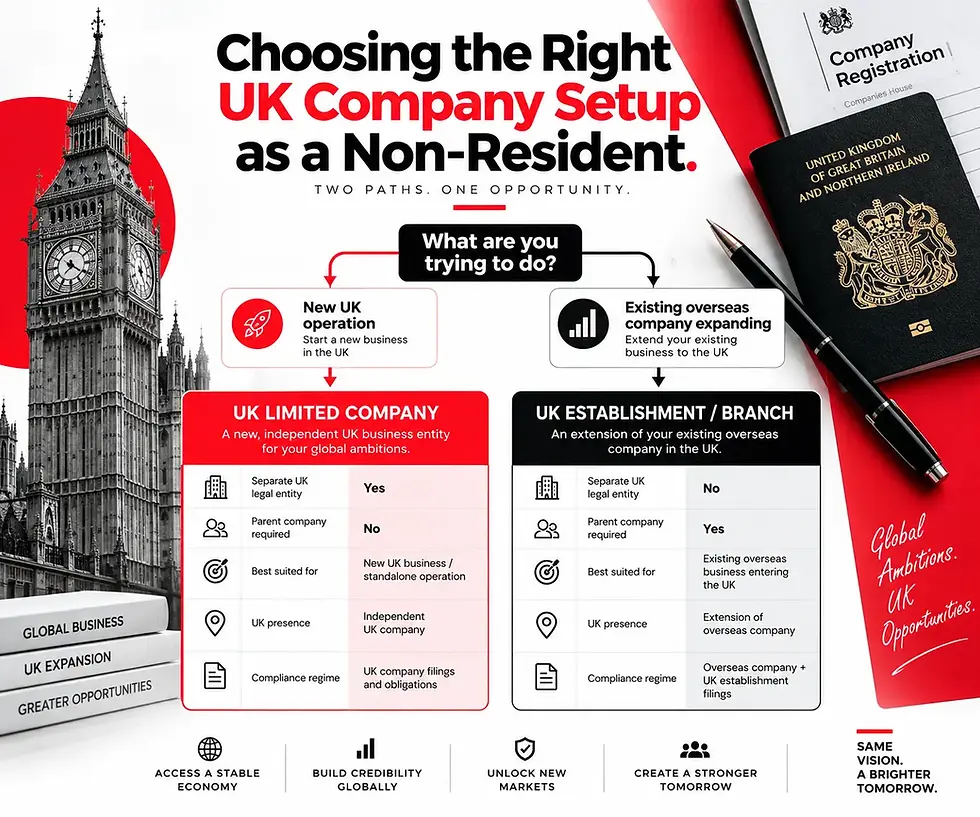
There isn't a single "best" structure — it depends on whether you're starting fresh or already operate a business elsewhere.
UK private limited company
A UK limited company is a separate legal entity from its owners. It has its own liabilities, its own accounts, and its own filing obligations, regardless of where the shareholders or directors live. This is the standard route for:
A brand-new business built around the UK market
Founders who want limited liability separate from their home-country business
Ventures raising investment or building a UK trading history
Some founders considering a UK company are also weighing whether to buy into an existing business instead of starting one from scratch — the due-diligence and structuring questions are similar even though the jurisdiction differs. Our guide on buying a business in the USA as a foreigner covers that acquisition route in a US context, if that's part of what you're weighing up.
UK establishment/branch of an overseas company
A UK establishment is essentially a place of business or branch of a company already incorporated overseas. It isn't a new UK legal entity — it's an extension of the existing foreign company operating in the UK. Overseas companies that establish a UK place of business generally have their own registration obligations with Companies House, separate from standard UK company incorporation.
This route tends to suit businesses that already have trading history, contracts, or brand equity abroad and simply want a compliant UK presence, rather than a brand-new entity.
UK subsidiary vs UK establishment
Factor | UK Limited Company | UK Establishment/Branch |
Separate UK legal entity | Yes | No |
Parent company required | Not necessarily | Yes |
UK presence | Depends on the business | Establishment in the UK |
Compliance regime | UK company obligations | Overseas-company obligations |
Best suited for | A new UK operation | An existing overseas company expanding into the UK |
Not sure whether a UK limited company or a UK establishment is the right fit for your business? Internation Corpus can help you assess the structure against your actual expansion goals before you file anything with Companies House. Get a consultation →
What Do You Need to Form a UK Company as a Non-Resident?
At a minimum, you'll need to settle the following before registering:
Company name — unique and compliant with Companies House naming rules
Registered office — a UK address for official correspondence
Directors — at least one, of any nationality or residence
Shareholders — at least one, again with no residency restriction
Persons with Significant Control (PSC) — anyone with significant ownership or control must be declared
Articles of association — the rules governing how the company is run (standard "model articles" are often sufficient)
Company information — SIC code, share structure, and registered details
Identity verification — confirming who the directors and PSCs actually are
Identity verification deserves particular attention. Since 18 November 2025, all directors must verify their identity with Companies House, either directly through GOV.UK, or via an Authorised Corporate Service Provider (ACSP) if using a formation agent or professional adviser. PSCs are being brought into the same regime on a phased timeline. Because these rules moved recently and are still being rolled out for existing companies, it's worth checking current Companies House guidance at the point you incorporate, rather than relying on older descriptions of the process.
A few other specifics worth knowing upfront:
Company name must be unique and end in "Limited" or "Ltd" (or the Welsh equivalents)
Directors must be at least 16 years old — there's no upper age limit or nationality restriction
SIC code — at least one Standard Industrial Classification code describing the company's activity is required at incorporation
How to Set Up a UK Company From Abroad

Determine the appropriate structure — new UK company or UK establishment of an existing overseas company
Decide ownership and management — who will be a director, who will be a shareholder, and who counts as a PSC
Choose the company name — check availability and naming rules
Arrange the registered office — your own UK address or a third-party registered office service
Prepare company information — SIC code, share capital, articles of association
Complete identity verification — for all relevant directors and PSCs
Register the company — submit the incorporation to Companies House
Set up tax and accounting processes — register for the relevant taxes and put bookkeeping in place
Arrange business banking or payment infrastructure — a separate process from incorporation itself
Establish ongoing compliance — confirmation statements, annual accounts, and filings going forward
How Much Does It Cost to Set Up a UK Company as a Non-Resident?
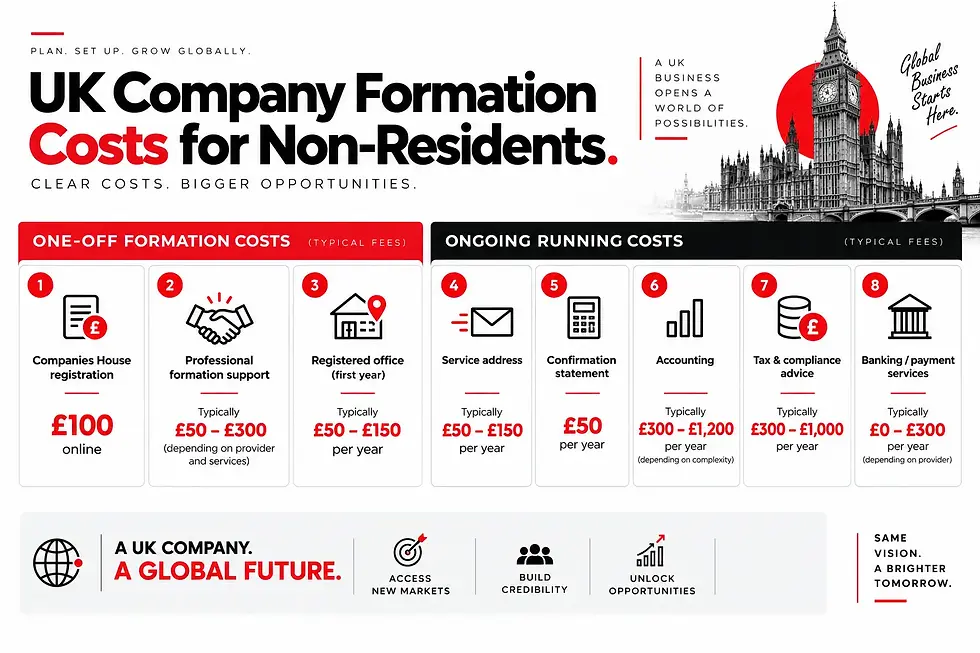
There's no single "total cost" figure that applies to everyone — it depends on how much you handle yourself versus how much support you use.
Cost category | What to consider |
Companies House registration | £100 for standard online incorporation (rose from £50 on 1 February 2026); £156 for same-day online filing; £124 by paper |
Confirmation statement | £50/year to file online (rose from £34 on 1 February 2026) — the main recurring Companies House cost after formation |
Registered office | If you use a third-party address rather than your own |
Service address | If required or desired for directors/PSCs |
Professional formation support | Varies significantly by provider and scope |
Accounting | An ongoing cost, not a one-off |
Tax and compliance advice | Depends on the complexity of your situation |
Banking or payment services | Provider-dependent, sometimes with account fees |
Virtual office | Optional, for a UK business presence beyond the registered office |
The key point: formation cost is not the same as the total cost of running a UK company. The £100 registration fee is a one-off; the ongoing accounting, tax, confirmation statement, and compliance costs are the real budget line to plan for. If you see a lower incorporation fee quoted elsewhere online, it's likely out of date — both figures above increased on 1 February 2026 under Companies House's reform programme.
Can a Non-Resident Open a UK Business Bank Account?
Company formation and business banking are separate processes. Registering a UK company does not guarantee that a bank or payment provider will open an account for you.
Can I open a UK business bank account without living in the UK? It's possible, but not automatic — approval depends on the provider's own risk and compliance checks.
Banks and fintech/business payment providers will typically look at:
Know Your Customer (KYC) checks on directors and shareholders
Beneficial ownership and PSC information
Evidence of genuine business activity
Source of funds
The nature of the business model
The country of residence of the owners and directors
In practice, non-resident founders tend to find fintech/EMI providers — Wise Business, Revolut Business, and similar — more consistently accessible than traditional high-street banks, since their onboarding is built for remote, international customers. Traditional banks such as NatWest, Lloyds, or Barclays remain an option and can suit founders who want a fully licensed UK bank rather than an e-money institution, but they typically expect more evidence of a genuine UK trading presence. It's worth researching both categories rather than assuming either one will say yes automatically. (For a side-by-side look at how this plays out for non-resident founders more broadly, see our comparison of US LLC vs UK Ltd structures for UAE residents, which covers banking trade-offs across both jurisdictions.)
What Taxes Does a UK Company Have to Consider?

UK tax obligations are not uniform for every company, and this is an area where the details genuinely matter.
Corporation Tax
UK-resident companies are generally within Corporation Tax on their worldwide profits. Non-UK-resident companies can still have UK Corporation Tax exposure in certain circumstances — for example, where they carry on a trade through a UK permanent establishment. Other rules can apply depending on the business.
VAT
Registration may be required depending on turnover and the nature of the goods or services supplied.
PAYE and payroll
Relevant once the company employs anyone, wherever the company itself is based.
Dividends
How dividends are taxed depends on who receives them and where they're tax resident.
Tax residence
A company's tax residence isn't automatically the same as its country of incorporation — HMRC looks at where central management and control actually happens.
Permanent establishment
Whether an overseas business has created a UK permanent establishment affects its UK tax exposure.
Double-taxation considerations
Relevant wherever an owner or the company itself has tax exposure in more than one country.
A UK company does not simply "pay UK tax on everything" — the position depends on residence, structure, and activity. Given how much this varies case by case, cross-border situations are a strong candidate for proper UK tax advice rather than general guidance.
Planning to operate across borders? Get your business structure and UK market-entry position evaluated by Internation Corpus before you commit to formation. Speak with an advisor →
Does Forming a UK Company Make You a UK Tax Resident?
No — not automatically. Company incorporation, personal residence, and tax residence are separate concepts that are easy to conflate.
Company incorporation is simply where the company is legally registered.
Company tax residence is generally determined by where central management and control sits, not just where the company was incorporated.
Individual tax residence depends on the personal circumstances and ties of the director or shareholder, not on owning a UK company.
Permanent establishment and tax treaty rules can further affect where tax is actually owed.
Owning a UK company does not, by itself, make a non-resident individual UK tax resident.
Should You Form a UK Company or Register Your Existing Foreign Company?
This is often the most important decision non-resident founders face, and it's worth pausing on before choosing either path.
If you... | Consider |
Are creating a new UK operation | A UK limited company |
Already operate an overseas company | A UK establishment/branch may be more relevant |
Want a fully separate UK entity | A UK limited company |
Need a genuine UK market presence | Compare both structures against your goals |
Need cross-border tax planning | Get professional advice before choosing |
An overseas company generally needs to register with Companies House if it establishes a UK place of business, under its own set of rules distinct from standard UK incorporation. Choosing between a new UK company and registering your existing overseas company as a UK establishment comes down to whether you want a fresh, standalone UK entity or simply a compliant extension of what you already run.
If you're weighing this against a US structure instead — for example, deciding between a UK entity and a US one for the same international business — our comparison of US Subsidiary vs Branch Office structures walks through the same subsidiary-vs-branch logic in a US context, which many non-resident founders find useful side by side with this UK decision.
What Happens After You Form a UK Company?
Formation is the start of the compliance relationship with Companies House and HMRC, not the end of it. Ongoing obligations typically include:
Confirmation statements (an annual check of company details)
Annual accounts
Corporation Tax returns and payments
Bookkeeping and financial record-keeping
Payroll, where the company has employees
Keeping company records up to date
Maintaining accurate PSC information
Reporting changes to company details
Ongoing identity verification obligations
VAT filings, where registered
Formation is the beginning of compliance, not the end of it.
Common UK Company Formation Mistakes for Non-Residents
Choosing a structure before fully understanding the business model
Treating a registered office address as an actual operating office
Assuming incorporation automatically creates tax advantages
Assuming incorporation guarantees a business bank account
Ignoring cross-border tax issues until they become a problem
Not understanding director and PSC requirements upfront
Failing to plan for ongoing bookkeeping and filings
Choosing a structure purely for perceived tax benefits, without wider planning
Assuming a UK company automatically provides immigration rights
Treating formation as a one-time administrative task rather than an ongoing commitment
Does Forming a UK Company Give You the Right to Live in the UK?
No. Forming or owning a UK company does not, by itself, give someone the right to live or work in the UK. Company formation, day-to-day business operations, and immigration status are three separate matters governed by entirely different rules. If relocation is part of the plan, it needs to be assessed on its own terms, alongside — not instead of — the company formation decision.
Choosing the Right UK Company Setup as a Non-Resident
You're an entrepreneur starting a new UK business → A UK limited company is generally the starting point to evaluate.
You already have a foreign company and want UK operations → Compare a UK subsidiary against a UK establishment/branch before deciding.
You want to sell to UK customers remotely → It's worth confirming whether UK incorporation is actually necessary for your model, or whether it can wait.
You want UK banking → Treat this as its own workstream, separate from formation.
You want to relocate to the UK → Company formation and immigration planning need to be assessed independently of one another.
How Internation Corpus Helps International Entrepreneurs Set Up in the UK
Formation agents handle the paperwork. Where Internation Corpus's role differs is earlier in the process — helping you decide which structure actually fits your business before you file anything:
Structure assessment — comparing a UK limited company against a UK establishment of your existing overseas entity, against the plan you actually have
UK market-entry planning — for businesses entering the UK from abroad rather than incorporating reflexively
Cross-border coordination — connecting the UK decision to the rest of your international structure, if you're weighing this alongside a US, UAE, or other jurisdiction (see our market expansion consulting guide for how that broader assessment works)
Ongoing expansion strategy — treating UK formation as one step in a wider international plan, not a one-off filing
Ready to move forward?
If you're planning to establish or expand your business in the UK from overseas, don't file with Companies House before the structure decision is settled. Internation Corpus works with international founders to evaluate the right UK setup, map out what it actually requires, and connect it to your wider expansion plan.
UK Company Formation Checklist for Non-Residents
Define the UK business objective
Decide whether you actually need a UK company
Compare a UK company against overseas-company establishment
Determine ownership structure
Identify directors and PSCs
Arrange a registered office
Complete identity verification where required
Register the company with Companies House
Determine Corporation Tax obligations
Assess VAT requirements
Set up accounting and bookkeeping
Evaluate banking and payment options
Establish ongoing compliance processes
Obtain professional tax or legal advice where appropriate
FAQs About UK Company Formation for Non-Residents
Can a non-resident form a UK company?
Yes. There's no residency requirement to incorporate a UK limited company — directors and shareholders can live anywhere, subject to Companies House identity verification requirements.
Can I register a UK company from abroad?
Yes, the entire incorporation process can be completed without being physically present in the UK, provided you meet Companies House's requirements for identity verification and registered office.
Do I need to live in the UK to own a UK company?
No. Ownership and residency are unrelated. You can own and direct a UK company entirely from overseas.
Can a foreigner be a director of a UK company?
Yes. There is no nationality or residency requirement for UK company directors, though identity verification rules apply to all directors regardless of where they live.
What address does a non-resident need for a UK company?
A UK registered office address is required for official correspondence. This can be your own address or a third-party registered office service, separate from wherever the business actually operates.
How much does UK company formation cost for a non-resident?
The Companies House registration fee is £100 online (as of 1 February 2026), but total cost depends on whether you use a registered office service, formation agent, accountant, or ongoing compliance support.
Can a non-resident open a UK business bank account?
It's possible but not guaranteed by incorporation alone. Banks and payment providers run their own KYC and risk checks on directors, shareholders, and the business itself.
Does owning a UK company make me a UK tax resident?'
No. Company incorporation, company tax residence, and personal tax residence are separate concepts, each assessed on its own criteria.
Should I form a UK company or register my overseas company?
It depends on whether you're building a new UK operation (favouring a UK company) or extending an existing overseas business into the UK (favouring a UK establishment/branch).
Does forming a UK company give me the right to live in the UK?
No. Company formation has no bearing on immigration status. The right to live or work in the UK is governed entirely separately.
This article is intended as general information, not legal, tax, or immigration advice.
UK company law and Companies House identity verification requirements have been changing, so it's worth confirming current rules directly with Companies House and HMRC, or with a qualified adviser, before acting on anything here.
Written by the Internation Corpus team · Internation Corpus helps entrepreneurs, startups, and investors establish and expand businesses across the USA and global markets through company formation, compliance, immigration, and business growth solutions. Learn more →
Comments