


SaaS Development Services: Build, Launch & Scale Your SaaS Product
Last updated: September 2026 | Written by Internation Corpus
Quick Answer: SaaS development services cover everything needed to take a software product from idea to launch: product strategy, design, development, integrations, testing, security, and support after launch. A SaaS development company can help with all of this, or just the parts you need.
Key takeaways
SaaS development is more than writing code. It covers the full product journey.
Cost and timeline depend on what you're building. There's no single fixed price.
Startups usually need a focused MVP. Growing businesses often need more integrations and scale.
A good SaaS partner asks about your business before jumping into tech talk.
Choosing between an outside partner and an in-house team is a real trade-off, not a simple choice.
What's in this article
Building a SaaS product takes more than writing code. You need to validate the idea, define the first version, design the user experience, build the product, integrate the systems it depends on, test it, and prepare it for real users.
SaaS development services bring these activities together, either as a complete product development process or as individual services based on what a business already has in place.
This guide explains what SaaS development services typically include, how the development process works, what affects cost and timelines, and what to evaluate when choosing a development partner.
What Are SaaS Development Services?
SaaS stands for software-as-a-service. It means software people use online through a subscription, instead of installing it on their computer. SaaS development services cover everything needed to turn a SaaS idea into a working product that customers can pay for and use, and to keep it running well after launch. This includes product strategy, design, development, integrations, testing, security, launch, and ongoing support.
Here's what a business usually gets from this kind of support:
A clear, tested scope, instead of a long list of "nice to have" features
A working product built to handle more users and more complexity as you grow
A design people can actually use without needing help
Connections to the payment, login, and business tools your product depends on
Security and data handling that fits the type of information you're working with
A clear path to launch, and a plan for what comes after
What's Included in SaaS Product Development?
SaaS product development isn't one single task. It's several connected pieces of work, and each one affects how the final product performs.
Product Strategy
Before any design or coding starts, product strategy answers the basic questions: who is this for, what problem does it solve better than other options, and what does the first version need to prove. Skip this, and teams often end up building something broad and generic that doesn't clearly beat any specific competitor.
Requirements and Planning
This turns strategy into something a team can actually build from. It usually includes user stories, feature requirements, performance and compliance needs, and a prioritized list of what to build first. Weak planning here is one of the biggest reasons projects run over budget later.
UI/UX Design
Design covers how the product is laid out, how users move through it, and what it looks like. For a SaaS product, this also means designing for daily use, not just a good first impression, since people will use it again and again if it's easy.
SaaS MVP Development
An MVP (minimum viable product) is the smallest version of your product that lets real users complete the main task and gives you honest feedback on whether the idea works. Good MVP development is as much about what you leave out as what you build.
Software Architecture and Development
This is the technical base of the product: how it's structured, how data is stored, which parts need to scale on their own, and how easy the codebase will be to maintain as the team and features grow. Decisions made here early, like how you handle multiple customers on one system or how the database is set up, are some of the hardest to change later. Cloud providers publish their own guidance on this. AWS's Well-Architected Framework is one example worth knowing about, whichever cloud platform you end up using.
API and Third-Party Integrations
Most SaaS products connect to other tools: payment processing, login providers, email and notifications, analytics, and sometimes industry-specific tools. This also covers building your own API if other systems need to connect to your product. Payment is a common example. Providers like Stripe publish clear developer documentation on how subscription billing and checkout usually work.
Testing and Quality Assurance
Testing covers whether features work, how the product performs under real load, and whether it works across browsers and devices. For a subscription product, a bug that breaks billing or locks people out costs you far more than a bug in a rarely used feature, so testing should focus on what matters most to the business.
Security and Data Protection
Security covers login and access control, encrypting data, safely handling payment and personal information, and staying on top of new risks. The OWASP Top 10 is a well-known list of the most common web security risks, and it's a good baseline to test any SaaS product against.
How much security work you need depends on the type of data you handle and who you're selling to. A product aimed at enterprise or regulated customers will face more scrutiny than a simple internal tool, and may eventually need ISO/IEC 27001 certification or a SOC 2 report. If you handle data from EU customers, you'll also need to understand GDPR rules around consent and data rights. None of this is required for every SaaS product, but it helps to know it early if enterprise customers are part of your plan.
Deployment and Launch
Deployment covers the infrastructure your product runs on, setting up environments, monitoring, and the release process. Launch also covers the practical side: support, onboarding, and getting ready for your first real users.
Ongoing Maintenance and Improvement
A SaaS product is never really finished. Maintenance covers bug fixes, monitoring, security updates, and keeping the infrastructure running. Improvement uses real usage data and customer feedback to decide what to build next.
SaaS Development for Startups
For startups, SaaS development usually comes down to one question: how do you find out if this product is worth building further, without spending more time and money than you need to find out.
That means:
Validate the problem before committing to a full build.
Keep the MVP focused on the core user outcome.
Prioritize features based on business value and learning, not the founder's full wish list.
Choose architecture that can support reasonable future growth without overbuilding.
Prepare onboarding, support, and analytics before bringing in early users.
Most startups revisit this plan more than once. The first scope is rarely the one that ends up shipping, and that's normal — the goal is to learn fast and adjust, not to get it right on the first try.
SaaS Development for Growing Businesses
For a business that already has customers and revenue, SaaS development services solve a different kind of problem.
Common reasons to build here include:
Internal tools that replace manual work or spreadsheets with proper software
A new customer-facing product built alongside your existing business
Digital transformation, modernizing how the business runs
New revenue, where the SaaS product becomes its own product line
Connecting to older systems the business already depends on
Scalability, since an established business often needs the product to handle real load from day one
Enterprise needs, like security certifications, SLAs, single sign-on, and procurement steps a smaller product wouldn't need
SaaS App Development Company vs SaaS Product Development Company
In real use, "SaaS app development company" and "SaaS product development company" mean pretty much the same thing. Both usually describe a provider that can take your SaaS idea through design, development, and launch, not one that only writes code against a spec you've already written.
Where there's sometimes a small difference, it's in focus, not a strict rule. A company known for "app development" may lean more toward building exactly what's specified. A company known for "product development" may lean more toward strategy and planning earlier in the process. Neither label guarantees this, so it's worth asking directly rather than assuming from the name.
What actually matters when you compare providers isn't the label. It's:
Whether they've built SaaS products specifically, not just general websites or apps
Whether they get involved in strategy, or only build from a spec you hand them
How they handle design, since developer-first teams often treat this as an afterthought
Their approach to security and data protection
What happens after launch: real support, or a handoff with no further help
How the SaaS Development Process Works

A clear process reduces the risk of building the wrong thing or hitting architecture problems late.
Stage | What Happens | What You Get |
Discovery | Requirements and goals get defined | A clear set of requirements |
Strategy | Product direction gets set | A product strategy |
Design | The user experience gets designed | Wireframes and UI |
MVP | Core features get built | A working MVP |
Testing | The product gets checked for quality | A tested product |
Launch | The product goes live | A live SaaS product |
Improvement | Feedback shapes what's next | Product updates |
1. Discovery and business requirements. The team learns your business goals, target users, competitors, and any budget, timeline, or compliance limits before any design work starts.
2. Product strategy. What you learned in discovery turns into a clear direction: what the product is, who it's for, and what success looks like for the first release.
3. Feature prioritization. Features get ranked by how directly they support the core value, so it's clear what's "must-have for launch" and what can wait.
4. UX/UI design. Wireframes and screen designs turn your priority features into something real, usually reviewed and adjusted before development starts.
5. MVP development. The core product gets built, focused on the features you prioritized, not the entire long-term roadmap.
6. Testing. The team checks that features work, the product performs well, and it holds up to real use.
7. Deployment. The product gets set up on live infrastructure, with monitoring in place.
8. Launch. The product goes live to real users, with support and onboarding ready.
9. Ongoing improvement. Data and feedback from real use guide what gets built next, and the cycle continues.
The exact process varies by product, but the important point is that development should begin with a defined problem and prioritized requirements rather than a list of features alone.
How Much Does SaaS Development Cost?
There's no single right answer to "how much does SaaS development cost," because it depends almost entirely on what you're building. Anyone who quotes a fixed price before understanding your requirements is guessing.
The main things that affect cost:

What Affects Cost | Why It Matters |
Product complexity | A simple, single-purpose tool costs far less than a multi-part platform |
Number of features | Features with real business logic cost more than simple data screens |
UI/UX needs | A highly custom, polished design takes more time than a plain, functional one |
Integrations | Each connection (payments, CRM, accounting, industry tools) adds build and test time |
Security needs | Handling sensitive personal, financial, or health data raises the bar on both build and review |
Architecture | Supporting many customers on one system and planning for scale takes upfront work that pays off later |
User roles | More roles and permission levels mean more logic to build and test |
Third-party APIs | Applies both to what your product uses and any API you build for others |
Testing depth | QA effort grows with how much the product does and how important each part is |
Maintenance and support | An ongoing cost after launch, not a one-time expense |
There is no reliable universal price for SaaS development. A focused MVP can cost substantially less than a complex multi-tenant platform with enterprise integrations, security requirements, and advanced workflows. The final estimate depends on the product scope, technical requirements, integrations, design, testing, and ongoing support.
A useful proposal should break down what is included, what assumptions were made, and what could increase the scope. Comparing what's actually included in a proposal, and what happens after launch, tends to be more useful than comparing hourly rates alone. A lower rate on a poorly scoped project can end up costing more than a higher rate on a well-managed one.
How Long Does It Take to Build a SaaS Product?
SaaS timelines depend on scope, team size, and how much planning is already done before development starts.
At a high level, the stages are:
Discovery, defining requirements and goals
Design, turning requirements into screens and flows
MVP development, building the core product
Testing, checking the product before release
Deployment, getting it ready for real users
A focused MVP can move considerably faster than a full SaaS platform, but there is no standard development timeline. Integrations, user roles, security requirements, product complexity, and the amount of planning completed before development starts all affect delivery time. If a provider gives you a fixed delivery date before your requirements are fully scoped, ask them to explain exactly what that date is based on.
How to Choose a SaaS Development Company
This is usually the point where you move from research to actually comparing providers, so it helps to be specific about what to check.
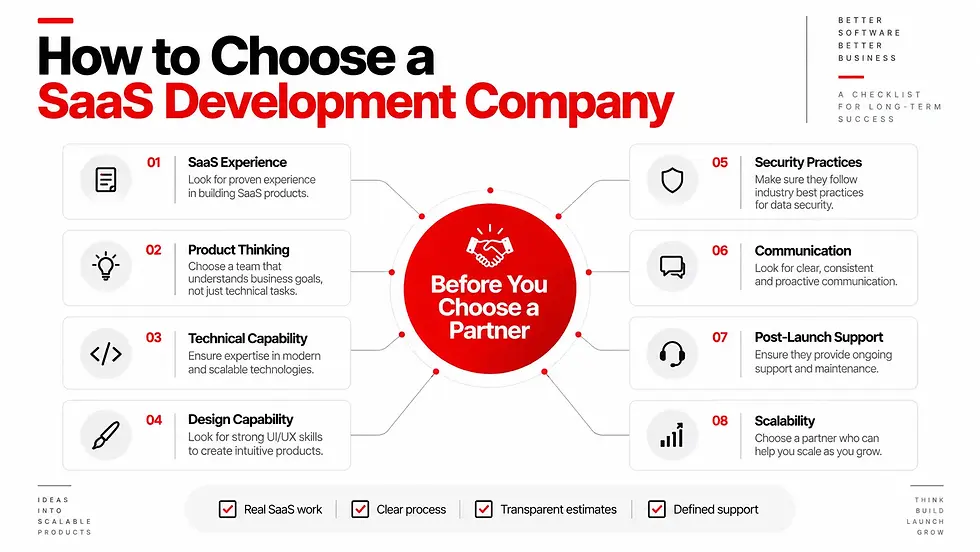
What to Check | What Good Looks Like |
SaaS experience | Real examples of SaaS products, not just websites or general apps |
Product thinking | They get involved in strategy and scope, not just building from a spec |
Technical skill | They can explain their architecture choices and why they fit your needs |
Design capability | Design is treated as core to the product, not an afterthought |
Security practices | Clear, direct answers on login, data protection, and risk management |
Communication | You know how often you'll hear from them and in what format |
Project management | A clear process for tracking progress and handling scope changes |
Post-launch support | A defined plan for what happens after launch, not a vague promise |
Scalability | Their proposed setup can grow without a full rebuild |
Integration experience | A track record with the systems your product will actually need |
Transparency | Estimates, assumptions, and risks are explained clearly, not glossed over |
Business understanding | They ask about your customers and goals before jumping to tech talk |
Before signing a development agreement, use a provider evaluation checklist covering technical capability, scope, security, communication, and post-launch support:
Can they show real SaaS work, not just general software projects
Do they ask about your users and business before proposing a solution
Do they explain their process clearly, from discovery through launch
Do they bring up security and data handling without being asked
Is post-launch support clearly spelled out
Are their estimates based on your actual requirements, not a generic number
SaaS Development vs Building In-House
Choosing between an outside SaaS development partner and building your own team is a real trade-off. There's no single right answer for every business.
Factor | In-House Team | SaaS Development Partner |
Hiring | You recruit, vet, and onboard each role yourself | The team is already in place with relevant experience |
Expertise | Limited to who you've hired; gaps can be costly to fill fast | Access to a wider range of specialists as needed |
Management | You need internal tech leadership to direct the team | The provider usually manages its own delivery |
Flexibility | Scaling the team up or down takes time | Easier to adjust scope as your needs change |
Scalability | Long-term capacity depends on more hiring | Often easier to bring in more capacity quickly |
Long-term ownership | Full knowledge of the product stays in-house | Needs clear documentation and a handoff plan |
Speed to start | Slower, since the team has to be built first | Usually faster, since the team already exists |
Cost structure | Fixed ongoing salaries and overhead | Usually scoped to the project or engagement |
Neither option is automatically better. An in-house team makes sense when the product is core to your business long-term and you can support ongoing hiring. An outside partner can make sense when speed, specific skills, or flexible capacity matter more than building permanent internal teams. Many businesses use a mix of both over time.
Common Mistakes to Avoid
Building too many features before checking if anyone wants the core product
Starting development without a clear idea of who the customer is
Treating design as a finishing touch instead of part of the core product
Underestimating security, especially for products handling sensitive data
Picking a tech stack before your requirements are clear, instead of after
Leaving integrations until late, when they're harder and more expensive to add
Not planning for scale, then hitting a wall as usage grows
Launching with no plan for support, monitoring, or what comes next
Choosing a vendor mainly because they quoted the lowest price
Skipping detailed requirements and hoping the team will figure it out as they go
Why SaaS Development Takes More Than Coding
A SaaS product that actually succeeds comes from several things working together: strategy that picks what's worth building, planning that scopes it realistically, design that makes it usable, development that builds it well, testing that catches problems early, a launch that's actually ready for real users, and steady improvement after that.
A team that's strong at coding but weak at strategy often builds something technically solid that customers don't want. A team strong at strategy but weak at execution ends up with a good plan that never becomes a real product. Both sides need to work together, which is why SaaS development looks more like a business and product partnership than a pure coding job.
SaaS Development Support at Internation Corpus
Internation Corpus provides SaaS project support, product development, web development, product launch support, and technology and digital product consulting.
The appropriate scope depends on the product. Some businesses need support from product planning through launch, while others already have an internal team and need help with specific parts of development.
For SaaS founders who also need support with business setup, IP, compliance, or banking, IC provides those services separately.
FAQ
What are SaaS development services?
SaaS development services cover the work needed to design, build, launch, and maintain a software-as-a-service product. This includes strategy, design, development, integrations, testing, security, and support after launch.
What does a SaaS development company do?
A SaaS development company helps take a SaaS product from an idea to a working product. This usually includes planning, design, development, testing, deployment, and often ongoing support after launch.
How much does it cost to develop a SaaS product?
Cost depends on complexity, number of features, integrations, security needs, and architecture. There's no fixed universal price. A provider should base an estimate on your specific requirements, not a generic figure.
How long does it take to develop a SaaS product?
It depends on scope. A small, focused MVP usually moves faster than a product with many integrations or enterprise needs. Treat any timeline given before requirements are finalized as an estimate, not a promise.
What's included in SaaS product development?

Usually: product strategy, requirements planning, UI/UX design, MVP development, software architecture, integrations, testing, security, deployment, and maintenance after launch.
Should a startup build an MVP first?
For most startups, yes. An MVP tests your core idea with real users before you commit to a full feature set, so you're less likely to spend heavily on features nobody uses.
How do I choose a SaaS development company?
Look at their SaaS-specific experience, whether they get involved in strategy, their design skills, security practices, how they communicate and manage projects, and what support looks like after launch. Don't choose based on price alone.
Can SaaS development companies help with product launch?
Many do, though it varies by provider. Launch support can include deployment, onboarding setup, and preparing for your first users, so it's worth confirming exactly what's included before you start.
Conclusion
SaaS development is a product lifecycle rather than a coding task. The right approach starts with a clear problem, a focused scope, and realistic technical requirements, then moves through design, development, testing, launch, and ongoing improvement.
If you're planning a SaaS product and need support with product development, web development, technology consulting, or launch preparation, Internation Corpus can discuss your requirements and help define the appropriate scope.
Planning a SaaS product? Contact Internation Corpus to discuss your requirements and determine what type of development support you need.


Comments