


How to Convert an LLC to a C-Corp: Step-by-Step (2026)
Updated: Aug 27
Last updated: July 2026
If you started your business as an LLC, that was probably the right call. It's cheap, quick, and simple to set up.
But now things have changed. Maybe you're talking to investors. Maybe you want to give employees real stock options. Maybe you're growing internationally. And everyone keeps telling you the same thing: "You need to become a C-Corp."
This guide explains why that advice exists, whether you actually need to follow it, and exactly how to convert an LLC to a C-Corp, step by step, in plain English. We'll also cover a few things most guides forget, like what changes for founders and team members based outside the US.
Quick answer: Converting an LLC to a C-Corp usually takes 4–6 weeks and costs anywhere from $100 to over $1,000 in state filing fees, depending on where you're registered. Most founders use "statutory conversion" — the simplest method — which transfers assets, contracts, and often your EIN automatically without dissolving the LLC. You'll need member approval, a state filing, new stock certificates, and corporate bylaws to complete it. |
LLC vs. C-Corp: What Changes

Before you touch any paperwork, it helps to know what you're actually changing. Here's the simple version:
• Ownership: LLC "members" become C-Corp "shareholders."
• Running the company: LLCs are flexible and informal. C-Corps need a board of directors, written bylaws, and regular meetings.
• Taxes: LLC profits are taxed once. C-Corp profits are taxed twice — once for the company, and again when shareholders get paid.
• Equity: LLCs can't give out stock. C-Corps can, which is why they're the go-to choice for hiring with equity or raising investment.
Here's the good news: a lot stays the same. In most conversions, your business doesn't shut down and start over. Your contracts, your IP, your business history, and often your bank accounts and tax ID carry straight over. You're not rebuilding your company — you're just changing its legal shape.
Why Founders Make the Switch
Three reasons come up again and again.
• Raising money. Most investors won't put money into an LLC. It creates tax headaches for them. A C-Corp fixes that, which is why investors almost always ask for one before they invest.
• Giving employees equity. LLCs can offer something called "profit interest units," but they're confusing and hard to manage. Stock options in a C-Corp are simpler and what most employees expect.
• Going global. C-Corps are recognized more easily outside the US. If you're planning to raise money from international investors or grow into new countries, this structure tends to cause fewer problems.
There's also a tax perk worth knowing: Qualified Small Business Stock, or QSBS, under Section 1202 of the Internal Revenue Code. If your C-Corp qualifies, you and your early team could avoid tax on a large chunk of your gains when you eventually sell your shares, sometimes up to $10 million or more. You need to hold the stock for over five years to get this benefit, and LLCs don't offer anything like it. It's one of the biggest reasons founders convert earlier rather than later.
Should You Convert? A Simple Way to Decide
Short answer: convert if you're raising money or issuing equity soon; stay an LLC if you're not. Here's the fuller version.
• Convert if: you're raising money soon, you want to offer real stock to employees, or you're aiming for an eventual sale or IPO.
• Stay an LLC if: you're profitable and bootstrapped with no plans to raise money, you like the simpler taxes and lower paperwork, or your focus right now is growing the business, not fundraising.
Still not sure? Have a quick chat with an accountant before you file anything. You can convert later, but doing it twice costs time and money you probably don't want to spend.
One more option worth a mention: instead of switching to a full C-Corp, some LLCs choose "S-Corp tax status" instead, which keeps pass-through taxation but changes how self-employment tax is calculated. It's a smaller move than a full conversion and doesn't let you take outside VC investment or issue multiple stock classes — so it solves a tax problem, not a fundraising one. If VC money or employee stock options aren't on your near-term roadmap, it's worth asking your accountant about this instead of a full C-Corp conversion.
The 3 Ways to Convert an LLC to a C-Corp

Which method you use depends on the state where your LLC is registered. There are three options, from easiest to hardest:
1. Statutory conversion. The easiest and most common route. Your assets, debts, and often your tax ID move over automatically. Your LLC doesn't shut down, it legally turns into the corporation. Most states allow this, including Delaware, Wyoming, California, and Nevada. You can see how Delaware structures this process directly on the Division of Corporations site.
2. Statutory merger. Used in the few states that don't allow statutory conversion, including New York, Kentucky, New Hampshire, West Virginia, and Guam. You create a brand-new C-Corp, merge your LLC into it, then formally close the LLC.
3. Non-statutory conversion. The slowest and most expensive option. Every asset and debt has to be moved over one by one, by contract. This is only used when the other two options aren't available.
Most founders will only ever need option one. If your state allows statutory conversion, that's almost always the easier and cheaper way to go.
How Much Does It Cost? State-by-State Breakdown
Costs and wait times vary a lot by state. Here's what to expect in four states founders ask about most:
State | Conversion Method | Filing Fee (approx.) | Processing Time |
Delaware | Statutory conversion | ~$293 total (Certificate of Conversion + Certificate of Incorporation) | A few business days (faster with expedited service) |
Wyoming | Statutory conversion | ~$100 (same as a new Articles of Incorporation filing) | Roughly 15 business days by mail; faster online |
California | Statutory conversion | $150 | About 5 business days, plus a Statement of Information due within 90 days |
Nevada | Statutory conversion | $350 (Articles of Conversion) + $75 (Articles of Incorporation) + $150 (Initial List) + $500 (Business License) | Typically 1–2 weeks depending on filing method |
Fees change over time, and some states add extra steps (California, for example, requires a separate filing within 90 days of conversion). Use this table to plan your budget, but double-check the current fee with your state before you file.
A Quick Example: Converting a Delaware LLC to a Delaware C-Corp
Here's what the process looks like in practice, using a simple example.
Say you and one co-founder run a Delaware LLC, split 50/50, and you're about to close a seed round. Here's roughly how it plays out:
4. You and your co-founder sign a conversion plan approving the switch to a C-Corp.
5. Your lawyer files a Certificate of Conversion and a Certificate of Incorporation with the Delaware Division of Corporations, paying around $293 in state fees.
6. The state processes the filing within a few business days (faster if you pay for expedited service).
7. Your LLC membership interests convert into shares — you and your co-founder each receive 50% of the new corporation's stock, matching what you held before.
8. You adopt bylaws, elect yourselves as the board, and hold your first official board meeting.
9. You apply for a new EIN, update your bank account, and let your seed investor know the entity is ready to receive their investment.
Total time: usually two to four weeks for a simple two-founder conversion like this, plus a bit longer if your bank needs extra time to re-verify the new entity.
Tax Mistakes to Avoid
This is the part worth reading slowly. Getting it wrong can be costly.
• Section 351. For your conversion to avoid triggering taxes, it usually needs to meet IRS rules under something called Section 351. In simple terms, your old LLC members need to end up owning at least 80% of the new company right after the switch. Most normal conversions meet this test easily, but check with a tax advisor if new investors are joining around the same time.
. 83(b) elections. If you already filed an 83(b) election for your LLC units, you'll usually need to file a new one for your C-Corp stock, yes, even though you already did this once. You only have 30 days from the date of your new stock grant to file it, using IRS Form 15620. Miss that window, and you could end up owing a lot more tax than necessary. This is one of the most common, and expensive, mistakes founders make.
• Double taxation, explained with real numbers. Say your C-Corp makes $100,000 in profit. The company pays tax on that first. Then, if any of it gets paid out to shareholders as a dividend, they pay tax on it again personally. LLCs skip this because profits are only taxed once. This isn't a reason to avoid converting — it's just something to budget for, especially in your first year or two.
None of this replaces talking to a real tax professional. But knowing these three terms ahead of time means you'll understand what they're telling you — and ask better questions.
What's Different for Non-US Founders
This is the part most guides skip completely, and it's often the most important section if your team or ownership includes people outside the US.
• Tax withholding. If someone outside the US owns part of the LLC, the conversion could trigger withholding tax rules, depending on what's being transferred and how. This depends heavily on your specific situation, so you'll want a tax advisor who has handled cross-border ownership before, not just a general startup lawyer.
• Banking headaches. A new tax ID after conversion often means your bank wants you to open a new account or re-verify your business. If you don't have a US Social Security Number or ITIN, this can turn into a slow process with extra paperwork and notarized documents. Our guide on opening a US bank account as a non-resident covers which platforms actually approve non-residents right now. Start this early so it doesn't hold up payroll or vendor payments.
• Registered agent and state registrations. If your LLC used a registered agent or was registered to do business in another state, don't assume this carries over automatically. Double-check that your registered agent covers the new corporation, and re-file any out-of-state registrations under the new company name.
If you're a non-US founder, here's the honest advice: get help with this section specifically. The conversion paperwork itself is usually simple. It's the tax and banking side where things go wrong — and those mistakes are much more expensive to fix later than to get right the first time.
Your Step-by-Step Conversion Checklist

Here's the order most conversions follow, no matter which state you're in:
10. Get approval from every LLC member for the conversion plan.
11. File your Certificate of Conversion and Certificate of Incorporation with your state.
12. Pay the state filing fee (see the table above for rough numbers).
13. Issue stock to former members, matching what they owned before.
14. Write corporate bylaws covering how directors are chosen and how voting works.
15. Elect your board of directors and appoint officers.
16. Apply for a new tax ID if needed (ask your accountant — this varies).
17. Update your bank accounts with the new company details.
18. Tell vendors, landlords, and lenders about the change.
19. Update your licenses, permits, and anything still showing "LLC" instead of "Inc."
Save or screenshot this list. It works just as well as a simple project tracker you can check off one step at a time.
What Happens After You Convert (First 90 Days)
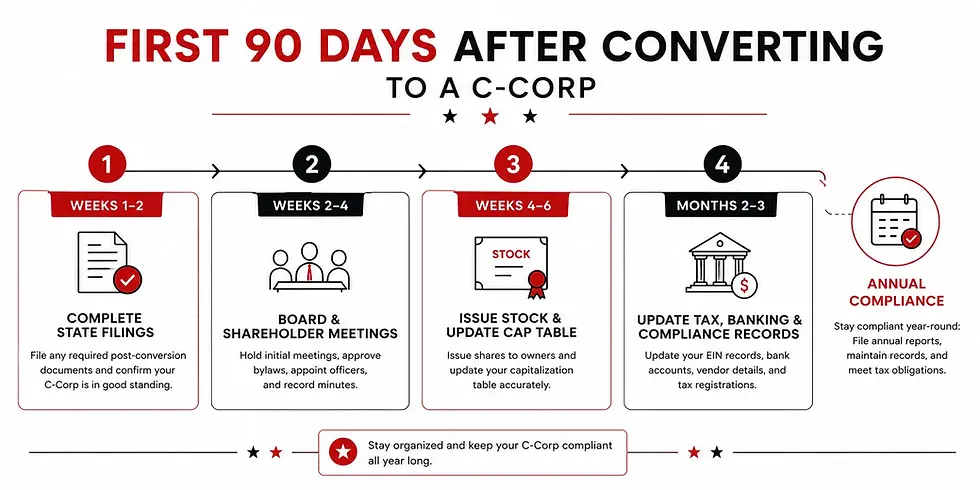
Converting isn't the finish line — it's the start of a new set of ongoing tasks. Here's what the first three months usually look like:
• Weeks 1–2: File any extra state paperwork (California, for example, needs a Statement of Information within 90 days).
• Weeks 2–4: Hold your first board meeting and shareholder meeting, and write down the minutes.
• Weeks 4–6: Issue stock certificates and update your cap table so ownership is accurate.
• Month 2: Make sure your new tax ID is updated everywhere — payroll, bank, vendor contracts, tax filings.
• Month 3 onward: Mark your calendar for annual report and franchise tax deadlines. These are easy to forget in year one, and late filings usually come with penalties.
Set your reminders now, while you're thinking about it. Missing a first-year filing deadline is one of the easiest — and most avoidable — mistakes after converting.
For a fuller list of what's due when, our 90-day US LLC compliance checklist walks through the filings founders miss most often in year one, many of the same deadlines carry over once you're a C-Corp. Set your reminders now, while you're thinking about it. Missing a first-year filing deadline is one of the easiest, and most avoidable, mistakes after converting.
Quick Glossary
• Statutory conversion: the simplest way to switch entity types. Assets, debts, and often your EIN transfer automatically, and your original business doesn't dissolve.
• Statutory merger: merging your LLC into a newly formed C-Corp, then dissolving the LLC. Used in states that don't allow statutory conversion.
• Section 351: the IRS rule that lets a conversion happen without triggering a tax bill, as long as former LLC members end up owning at least 80% of the new corporation.
• 83(b) election: an IRS filing that lets you pay tax on stock now, while its value is low, instead of later as it vests. Must be filed within 30 days of receiving the stock.
• QSBS (Qualified Small Business Stock): a tax rule that can let founders exclude a large portion of their gains — sometimes $10 million or more — when they sell C-Corp stock held for over five years.
• Double taxation: when profits are taxed once at the corporate level and again when paid out to shareholders as dividends. This applies to C-Corps, not LLCs.
Frequently Asked Questions
Do I need a new tax ID after converting?
Usually, yes. It depends on how your conversion is structured, so check with your accountant. But most founders do end up applying for a new EIN.
Will converting trigger a tax bill?
Usually not, as long as it meets IRS Section 351 rules. There are exceptions — for example, if your LLC owed more than it owned at the time of conversion. Always double-check with a tax professional before filing.
Can I still operate outside Delaware if I convert to a Delaware C-Corp?
Yes. You'll usually need to register as a "foreign entity" in whatever state you actually operate in, which means one more filing and fee.
How long does the whole thing take?
The state filing itself is often done within a few days to two weeks. But once you add member approval, bylaws, issuing stock, updating your bank, and notifying vendors, plan for four to six weeks total — longer if international ownership is involved.
Converting from an LLC to a C-Corp is a common step for a reason, and if you're raising money or building a team with equity, it's usually the right one to take. The filing itself is the easy part. The tax details — and for international founders, the banking and cross-border pieces — are where most people get stuck. Get those right early, and the rest is pretty straightforward.
Thinking about converting your LLC to a C-Corp before a raise? Our team at Internation Corpus handles the filing, the EIN, the bylaws, and the cross-border banking questions that trip up non-US founders most, so you can stay focused on the raise instead of the paperwork. Get in touch for a quote and we'll walk you through what your specific conversion needs.

Comments