


Foreign-Owned LLC Reporting and Taxes Explained
A foreign-owned U.S. LLC can owe zero federal income tax and still owe the IRS a filing. Foreign-owned LLC tax depends on what the business does, while filing requirements can apply even when no federal income tax is due. The filing requirement, mainly Form 5472, depends on whether money moved between the LLC and its owner. Confusing the two is where most foreign founders get into trouble, usually the $25,000 kind.
Here's the version that actually answers both questions, plus the parts most guides skip: what counts as a reportable transaction, who counts as a related party, what changes with more than one owner, and where the BOI rules actually stand in 2026.
If you're still in your first few months after forming the LLC, our 90-day compliance checklist covers the earlier steps (EIN, banking, registered agent) that this article assumes are already done.
Foreign-Owned LLC Tax: Do You Owe U.S. Tax, or Just Owe a Filing?
Depends on the business, not the owner's passport.
A single-member LLC owned by a non-U.S. person is a disregarded entity by default. The IRS looks straight through it to the owner. If there's no U.S. trade or business and no U.S.-source income taxable to a nonresident, there can be zero federal income tax.
If the LLC is engaged in a U.S. trade or business, that changes. Income effectively connected to that business gets taxed at the same graduated rates a U.S. taxpayer pays, and a return has to go in.
Either way, the filing question is separate. Even at zero tax, Form 5472 can still apply.
What actually triggers Form 5472

Not income. Transactions.
A foreign-owned single-member LLC files Form 5472 with a pro forma Form 1120 when there are reportable transactions between the LLC and its foreign owner (or another related party). No income doesn't mean no filing. No transactions might.
Here's what counts:
capital contributions from the owner
distributions back to the owner
loans, in either direction
rent
service payments
reimbursements
anything else that runs between the LLC and a related party
A $200 reimbursement and a $200,000 related-party payment sit in the same category even though they're nowhere near the same size. Size doesn't decide whether something belongs on the return. Category does.
The habit that saves you here: log every transfer between you and the LLC as it happens. Don't try to reconstruct it in March.
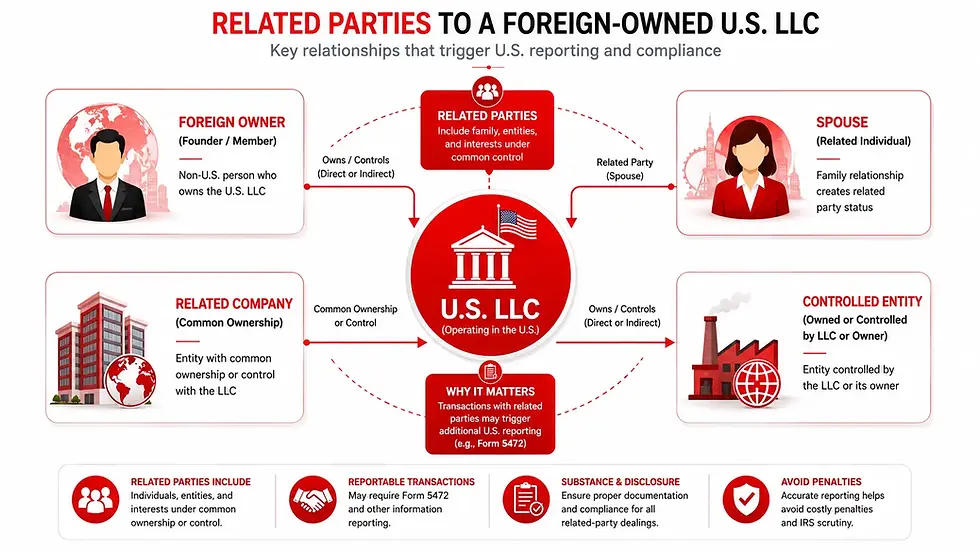
"Related party" is wider than you think
Most founders assume it means another company they own. It's broader.
The foreign owner is a related party to their own LLC, obviously. Past that, attribution rules pull in family members and controlled entities depending on the structure: spouses, in some cases parents, children, siblings, and entities you or those people control. The exact reach depends on which rule applies (IRC sections 267(b), 707(b)(1), and 482 come up here, along with modified constructive-ownership rules, all referenced directly in the Form 5472 instructions), so treat this as a signal to map your actual relationships and check them, not a reason to assume a family transfer is automatically safe or automatically reportable.
Does having U.S. customers create U.S. tax?
No. Not by itself.
A founder based abroad, selling to U.S. customers, with no U.S. office, no U.S. staff, and no U.S. agents signing deals on their behalf, usually isn't engaged in a U.S. trade or business. The IRS test looks at things like a fixed U.S. place of business, U.S. employees, or regular activity through U.S.-based agents, not the location of the customer's credit card.
Flip it around: a founder running the business through U.S. staff or a U.S. office is a different case entirely, and that usually does create ECI and a filing obligation.
If you're not sure which side you're on, that's worth a real conversation with a tax professional. "I have U.S. customers, so I must owe tax" and "I work remotely, so I owe nothing" are both guesses, not answers.
More than one owner changes everything

Every generic guide assumes a single-member LLC. Add a second owner and the whole analysis shifts.
Structure | What applies |
Single-member, disregarded | Owner-level tax; Form 5472 + pro forma 1120 if reportable transactions exist |
Multi-member, partnership (the default) | Form 1065; foreign-partner withholding if there's ECI allocable to a foreign partner |
Elects or is classified as a corporation | Corporate return rules; Form 5472 if 25%+ foreign owned and reportable transactions exist |
The partnership path brings in Forms 8804, 8805, and 8813. Form 8804 is the partnership's annual withholding return. Form 8805 goes to each foreign partner showing their share of ECI and withholding. Form 8813 is the payment voucher used during the year. None of that exists in the single-member playbook, which is exactly why confirming classification first matters more than jumping to a checklist.
Missed Form 5472. Now what?
There's relief available. It's not automatic, and it's not a guarantee either.
Treasury regulations apply the reasonable-cause exception more liberally to a small corporation that has $20 million or less in gross receipts, had no knowledge of the filing requirement, has limited U.S. presence, and cooperates fully once the IRS asks for records. All four, together, evaluated on the actual facts.
Being under $20 million doesn't mean the penalty disappears. It means the IRS applies the standard more generously when the other conditions line up. If you find a missed filing, file it now and get the reasonable-cause position reviewed properly. Don't assume you're safe. Don't assume you're doomed either.
This is a narrow, fact-specific area of the rules; it's worth reviewing your actual situation with our team rather than relying on a general article. Book a consultation.
How the filing actually works
This part trips people up because it doesn't behave like a normal IRS filing.
Attach Form 5472 to a pro forma Form 1120. Write "Foreign-Owned U.S. DE" across the top of that 1120. Need more time? File Form 7004 by the original due date, same notation across the top.
None of it e-files. It goes by fax or mail, to a dedicated address, not the regular Form 1120 filing address. As of now, that's:
Internal Revenue Service, 1973 Rulon White Blvd, M/S 6112, Attn: PIN Unit, Ogden, UT 84201, or fax 855-887-7737.
Check both against the current IRS instructions before you send anything. This is one of the details that changes without much warning.
The BOI question, actually current
U.S.-formed LLCs have been exempt from federal BOI reporting since FinCEN's interim rule in March 2025. FinCEN made that exemption permanent with a final rule effective August 14, 2026, after the underlying Corporate Transparency Act was upheld and the scope was narrowed through litigation. You can confirm the current status directly on FinCEN's BOI page.
What still matters is where the entity was formed, not who owns it. A Delaware LLC owned entirely by a non-resident: U.S.-formed, exempt. A company formed under foreign law that registers to do business in a U.S. state: still potentially inside the BOI reporting rules.
Some older guides still tell foreign owners of U.S. LLCs to file BOI reports. That's stale advice as of this rule. Worth flagging if you're comparing against something you read a year or two ago.
FBAR and FATCA aren't the same filing
Form 5472 reports transactions between you and your LLC. FBAR and FATCA are about foreign financial accounts, not about the LLC's transactions with you.
Owning a foreign-owned U.S. LLC doesn't automatically create an FBAR obligation. Whether it applies depends on the foreign accounts involved, separate from anything happening on Form 5472. Treat these as three different questions, not one filing that covers everything.
Federal might be zero. State usually isn't free either.
A clean federal answer doesn't end the conversation. States run their own rules, and they vary enough that the state you form in changes your ongoing workload. Our Wyoming vs Delaware comparison is worth a look if you're still choosing, or double-checking what you signed up for.
Depending on where the business operates, obligations can include annual report filings, franchise or minimum taxes, state income tax, and sales tax collection. Sales tax gets its own mention because of Wayfair: states can require collection based on economic activity, a volume of sales or transactions, without a traditional physical presence. "I don't have an office there" stopped being a reliable answer once that ruling landed.
Skip the shortcut that says "my work happens outside the U.S., so nothing applies here." The better move is checking what your entity, activities, customers, employees, property, and sales actually trigger, state by state.
If you're funding the LLC from India
Everything above is the U.S. side. If you're an Indian resident funding or owning a U.S. LLC, there's a separate FEMA and RBI track running in parallel, including ODI reporting through Form FC and an annual APR filing, independent of anything the IRS requires. Our guide on opening a U.S. LLC from India walks through that side in detail.
Checklist
Confirm classification: disregarded entity, partnership, or corporation
Check for a U.S. trade or business and whether ECI applies
Review every owner-LLC transaction for the year against the reportable-transaction list
Map related parties before deciding what counts
File Form 5472 with pro forma Form 1120 by fax or mail if needed
Multiple owners: confirm whether Form 1065 and Forms 8804/8805/8813 apply instead
Check FBAR/FATCA separately, based on foreign accounts, not on the LLC itself
Confirm BOI status: U.S.-formed LLCs are currently exempt, foreign-formed registrants aren't
Review state annual report, franchise, income, and sales tax nexus, state by state
If something was missed, fix it and get reasonable cause evaluated on the actual facts
Where to start
Not with the tax rate. Start with what the LLC is classified as, what it actually does, and where the money moves. Federal income tax, Form 5472, partnership withholding if there's more than one owner, state obligations, and BOI status are five separate checks. Running all five beats guessing at one and hoping it covers the rest.
If you'd rather have someone map this against your actual structure instead of a general article, talk to our team. We work with founders running U.S. LLCs from outside the country and can tell you exactly which of these apply to you.

Comments